Thursday, January 31, 2013

Masjid-e-Qurtuba, The Lament of Andalusia


رثـــــاء  الأنـــدلــس
حيث المساجد قد صارت كنائسَ ما      فـيـهنَّ  إلا نـواقيسٌ وصُـلبانُ
حتى  المحاريبُ تبكي وهي جامدةٌ      حـتى الـمنابرُ ترثي وهي عيدانُ


Where the mosques have become churches,
Where only bells and crosses may be found
Even the mihrabs weep
Though they are solid,
Even the pulpits mourn
Though they are made of wood


For Slide Show Click Here
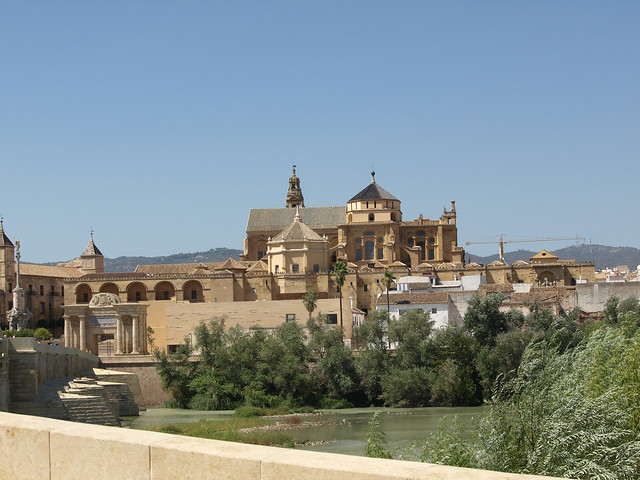


Masjid e Qurtuba was the last stop we had for Cordoba, and hence the last place I visited related to Muslim Andalus. All of us build up an image in our minds when we have a lifetime hearing about it. That image may be quite different from what it is in reality. Similar was my experience about the Masjid. My initial impression was," I expected something different!" No dome, gunbad, no high ceilings and the mosque was DARK. Then the direction of the qibla  and the privileged priority seating of the royal family, with a separate entrance. All of this was quite difficult to overcome. But during the tour, the majesty of it weighed on me slowly and by the end of the tour, I had to make one round again, on my own, to reflect on it. And reflected I indeed, trying to absorb the image of the mosque as it would have been in the days when faithful flocked it and answered the call of the muezzin.


And since coming back and reflecting on it, and reading about it, the image and the grandeur of the Mosque has only magnified.

It is indeed a work of art, love, dedication and faith. The idea of the mosque was to make the faithful transcend time and space and take him far off away to the never-to-return oasis of Syria, Damascus, in the middle of a desert, and sure it does that.


تیرا جلال و جمال مرد خدا کی دلیل 
وہ بھی جلیل و جمیل ، تو بھی جلیل و جمیل 
تیری بنا پائیدار ، تیرے ستوں بیشمار
شام کے صحرا میں ہو جیسے ہجوم نخیل 


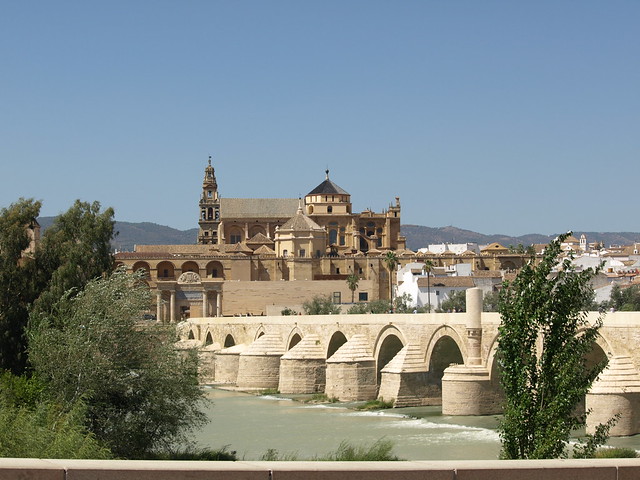
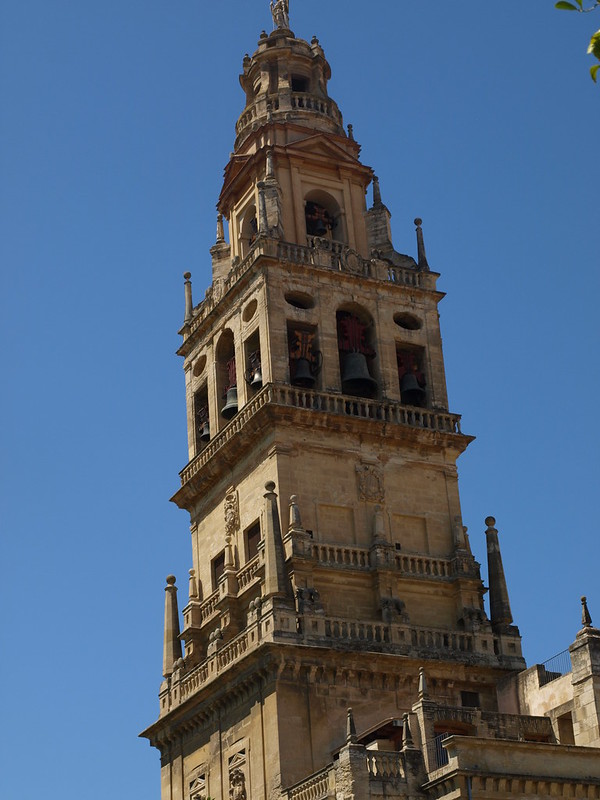
The guide took us to the mosque in the end of the city tour; he wanted the best for the last. By that time we had visited the Alcazar, the streets and patios of Cordoba, the Horse yards, the Inquisition halls and the statues of sons of Cordoba. We entered through the Northwest door, and what we see is a big courtyard with palm trees. It used to be the courtyard where the faithful would have performed the wuzu,  the ablution before entering the mosque proper. You see the  minar, now a Belfry like the other towers of mosques, at the northern end. The walls of of the courtyard had the pieces of the ceiling wood. Looking at the building of the mosque from the courtyard you see a big square protrusion in the middle of the roof. That is what I realized later on, was the cathedral in the middle of the mosque.  

And then we entered the masjid proper. It was strange, a sense of hesitancy  Here I am entering one of the greatest mosques in the history, and everyone, including myself, is entering with their shoes on. Our emotions run high when a non Muslim enters, even inadvertently, to our mosques with shoes on. They should know better, etc etc. Now I am doing the same! To my surprise, I did not feel enraged, I somehow accepted it and convinced myself ie this is not a mosque anymore and faithful had themselves handed over the keys of the city and the mosque to the Christians almost 900 years back, June 29th, 1236 to be exact.
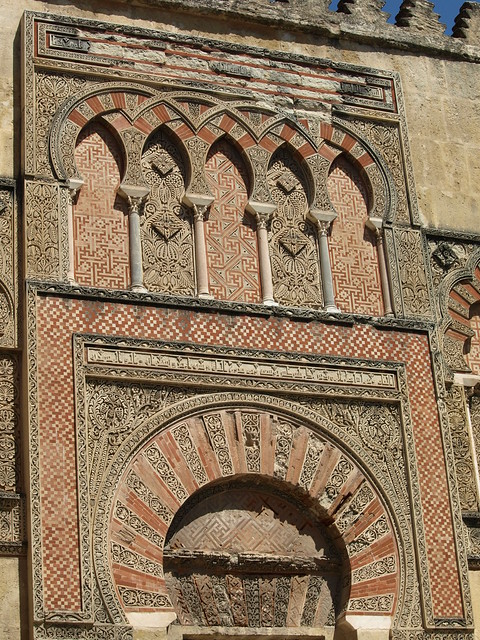


It is not clear to me whether anyone has ever prayed in this mosque after that day. I am not sure about the story behind Iqbal's picture praying namaz which sitting (qaida)  in the masjid, but in 2010 Austrian Muslims tried to pray in the mosque and were arrested.


Floor Plan


Floor plan

QIBLA'S DIRECTION:

As soon as we entered the mosque, the guide explained the direction of the qibla and the reason, as he thought, of it not facing Mecca. It bothered me then and it bothers me now, although there are more than one 'logical' reasons to explain that. (guide's and otherwise)

 The true direction of qibla from Cordoba is 100 degree East. Doubt that the Abdur Rahman I would not have known that. So far I have heard and read a few theories about it.

  1. It was built on a Roman Visigoth church, and the construction of the church demanded the layout to be the way it was ie that the naves should be north south and not east west. . This was narrated by our tour guide.
  2. Abdur Rahman wanted to imitate and surpass the Ummayad Mosque in Damascus, and as the Qibla is south from Damascus, he replicated it in Cordoba. That is mentioned by some orientalists. Not to forget that the direction of the original mosque, Masjid-e-Nabwi, the Prophet's Mosque is facing south. So in a way the Cordoba Mosque, like the Damascus Mosque and the Prophet's Mosque in Medina, would face south. 
  3. Maliki school of thought allowed a greater latitude in the qibla being away from the right direction, so it was okay.
  4. Hakam II, to whom is the credit for the magnificent Mehrab,  had a chance to redirect the qibla. He refused, stating that his creed is to obey and follow, mazhabuna ittiba'
The other issue which bothered me was that there is a separate section for the royal family, with a separate entrance.  Here again it is stated that Hakam II tried to recreate the ambiance of the Prophet's Mosque, where the household is nearby and almost within the mosque.

I do not know whether it was a custom in the early centuries of Islam, but we grew up with this concept of mosque being the great equalizer and who so ever comes first occupies the front rows. 

HISTORY OF EXPANSION:
As you see the floor plan, the mosque has undergone many expansions. The original mosque of Abdur Rahman I was what is now the north west part of the complex. Later Abdur Rahman II expanded in the direction of the qibla and doubled the size of the mosque. Abdur Rahman III made the tower and make some changes.

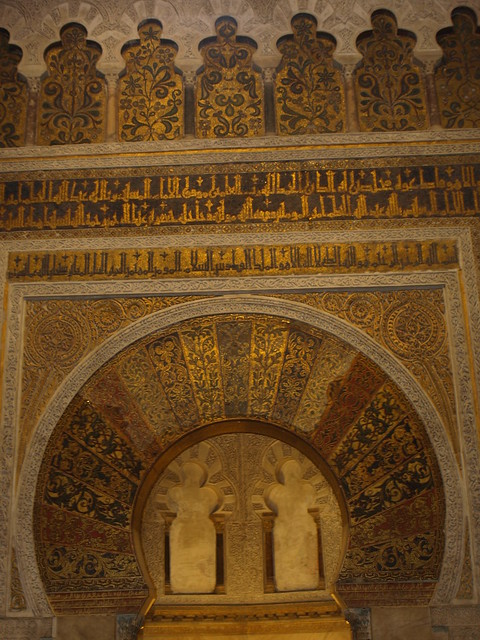
Later Hakam II extended it further south, and mehrab was once again erected. The most beautiful section of the mosque. Fine work, with artisans commissioned loaned/forcibly asked from Byzantine christian land, and plenty of gold etc. More on it later. 

The fourth expansion was by Al Mansur across the whole length of the mosque and the courtyard. It just expanded the size of the mosque as he, like many of his predecessors wanted to etch his name in the history as one of those who expanded the mosque.

With this final expansion, the Qurtuba Mosque became the largest mosque of the world in its time. Maliki tradition made it obligatory for the faithful to congregate in one central mosque for Friday Prayers, even when the city population had increased. It was one of the main reasons of continual expansion.

On a Friday prayer there would be 600,000 congregants  The size was 250,000 square feet, quite large even by today's standard. Faisal Mosque's covered area is 54,000 sq ft.

Now the cathedral which sits inside it, has no more than 20 to fifty parishioners on a Sunday. 

DIFFERENCES FROM THE DAMASCUS MOSQUE:

Although the plan of Damascus was imitated, there were two main differences. One was the height of the arches, it was higher in Cordoba, and the second was the alignment of the columns. In Damascus the columns are parallel to the wall of Qibla. In Qurtuba, it was perpendicular to the wall of Qibla, which is the tradition of Visigoth church it replaced. Most of the churches have this alignment ie from the door of the church to the other end.


PRAYER HALL:
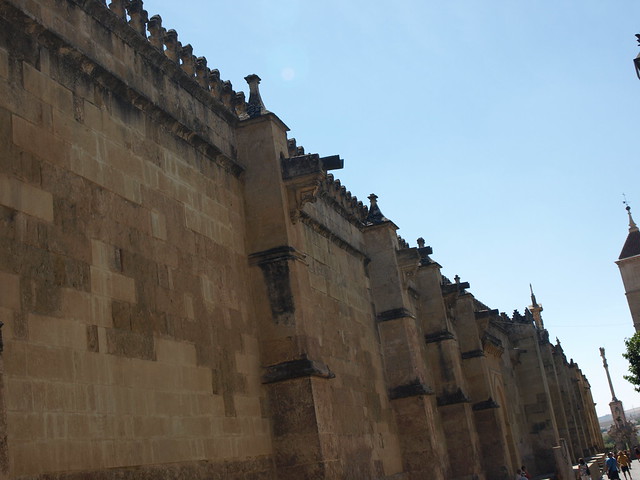
The walls are original, as old as 1200 years old. It is quite a marvel. The roof and the floor are not original any more, Many of the roof wood is hanging outside in the courtyard for display.

As soon as you enter the main hall, they want to make sure that you see the relics of the original Visigoth Roman church, which is buried under the floor of the mosque. They have glass on the floor and you can see a part of the original church.

WHY THE MOSQUE WAS BUILT ON THE CHURCH?
Vatican has a simple explanation. It was the holiest place in the city and the invaders, ie Muslims occupied it and made their own church on top of the demolished church. Muslim historians do not deny the preexistence of the church on the site. They claim that for a long while the Muslims prayed in the church along with the christian, in the same tradition as Muslims did initially in Jerusalem (and in fact in Medina). It was later when Abdur Rahman I decided to create a monument of a definite transition in history that the church was bought. Christians were given enough money to build a church at a different location.

COLUMNS:
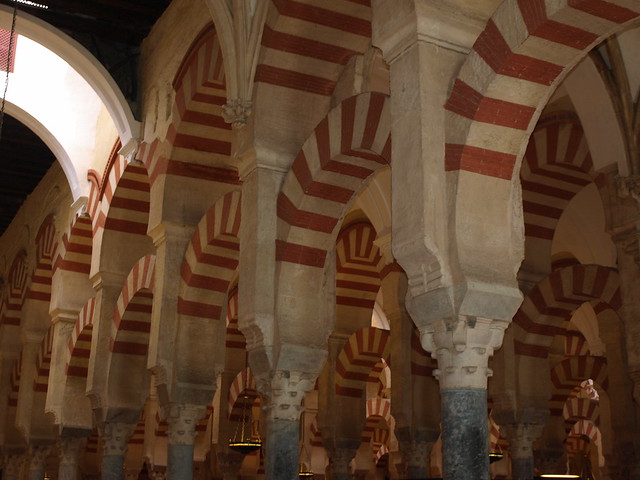

The columns are double arches, the bottom one is a typical Andalusian horseshoe arch and the top one is a semicircular arch. The repeated pattern of red and white gives a strange and stark feeling. these are different stones, ie red bricks and beige stones. Esp if one is able to imagine the endless columns without the Cathedral sitting in the middle of the mosque, Then it would have been a lot of light and one could see across the whole length and diagonally across the hall.

MEHRAB:
The acoustics of the mehrab was phenomenal. It with a separate dome of its own, converted the box of the mehrab into a living microphone. Without the aid of modern speaker system, it was a marvel in it self that the  faithful in the last row was able to hear the Imam during the sermon and the prayers.

COURTYARD:
This is perhaps the area closest to its original form, and when one enters the mosque through this, one gets the feeling of being inside something holy. It was supposed to be filled with orange trees and was uses as the area for ablutions. Now it has tall palms and offers a serene area to reflect.

THE FALL OF CORDOBA:
when the Moors, ( and by this time it were not the Ummayads, or the Al Murabitoon or the Almuwahids, but the taifa rulers,  petty states, of Cordoba) finally agreed to open the door of the city, they prayed in the mosque for the final  time, Fajr of June 29, 1236.. The invader, Ferdinand III of Castile, who later earned papal sainthood and became the Saint Ferdinand, San Ferdinando, did not enter the mosque for quite a while.

The mosque was washed and cleansed of the infidels and consecrated. Then the King Ferdinand entered and was immediately enamored by the thing of beauty he saw. A part of the mosque was declared the church and services were offered there.

For a long time, the elite and the rulers of the area felt privileged enough to be buried inside the mosque, and one sees many of the graves inside the mosque.

Three centuries later, in 1532 the clergy was influential enough in convincing the King Charles V, who had never seen the mosque to build a cathedral in the place of the mosque. He allowed it and the center of the mosque was demolished to make the cathedral. Later when the King arrived to see the progress, he is claimed to have said, that you have replaced what was exceptional with what is ordinary. He decided the cathedral not to be larger than what was already built and the rest of the mosque structure was left intact. So is it today.

CATHEDRAL:
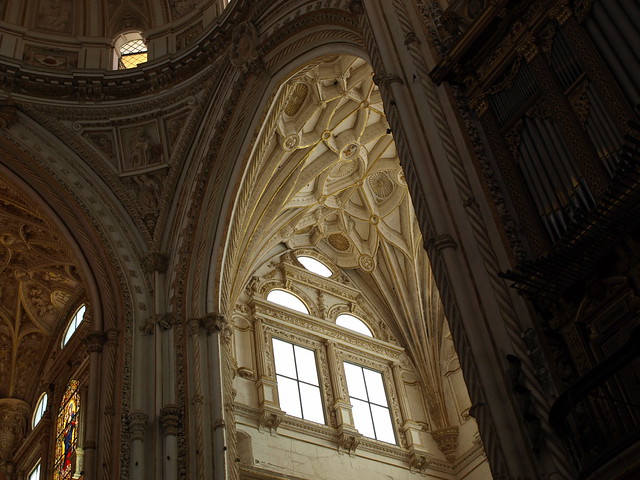


If for a minute one does not think of it in religious terms, the cathedral is pretty beautiful. It offers the contrast of what a mosque and a church are similar in and are different about. It sits in the middle of the mosque, and the layout is east west axis.

TREASURY:
Next to the mehrab is the treasury where some important artifacts are placed.
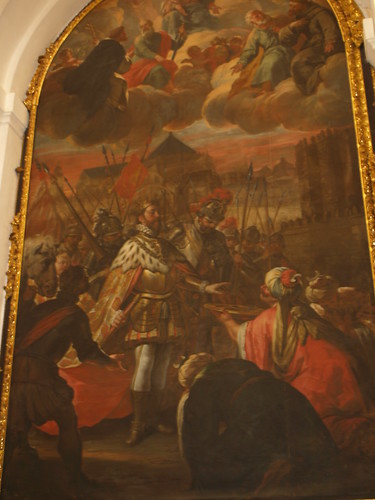
There used to be a treasury in the times of Ummayads and reportedly the four pages of Quran drenched in blood, when Caliph Usman was killed, were displayed here. Ummayads had strong sense of destiny as the bearers of Quran as one of them, Usman was the first to compile the Quran in one book form and ironically he was killed while reading Quran. It is not clear to me where those relics are, but now the treasury, rebuilt by Christians is their museum of conquest.
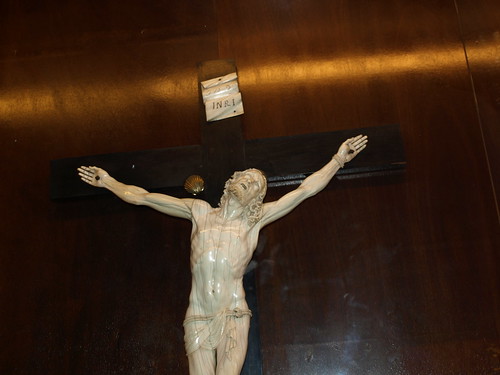


It includes the painting of the Moors giving away the city keys to Ferdinand, It has the famous Christ  which is taken out every year in the procession.


http://www.flickr.com/photos/nasirgondal/7981477792/sizes/z/in/set-72157632530655915/
There is a Christ statue made out of one long piece of ivory, which is perhaps the biggest single ivory statue of Christ.


OFFICIAL GRAFFITI:
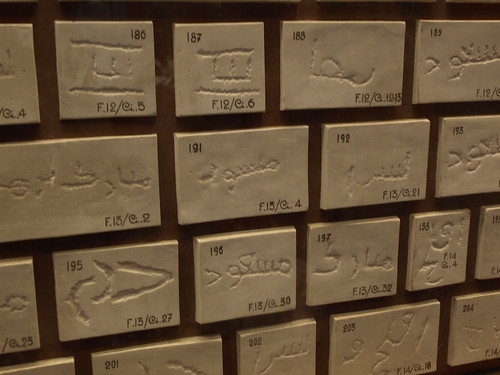
Many of the original carpenters have left their names inscribed and they are on the display. One can see the names Masood, etc etc.


اے حرم قرطبہ ! عشق سے تیرا وجود 
عشق سراپا دوام ، جس میں نہیں رفت و بود 
ا
-------------------------------------------------


Thursday, January 24, 2013

The Year of The Elephant


کافر ہوں کہ مومن ہوں خدا جانے میں کیا ہوں
میں بندہ ہوں ان کا  جو ہیں سلطان مدینہ 
Sir Krishan Prasad Shad.

Tradition has is that the Prophet was born and died in the Rabial Awal, the third month of the lunar Hijazi calender. Today, Thursday is the twelfth, considered by many as the day of his arrival and departure from the world.

Muhammad the man has intrigued many, perhaps more than anybody else in the history. He has been loved and hated, maligned and  praised, worshiped and cursed, both in his lifetime and long after that.

Regarding historic evidence, existence of  none of the earlier 'prophets' can be independently  verified. The word has yet to know scientifically whether Moses or Jesus ever lived on this earth. For what we know, there may have not been any of the Biblical figures, but Muhammad is a reality, documented by the uninterrupted narrations/traditions of his life and words.

I do not think that there is any other person who has single handed delivered so much. All his limitations aside, medical or psychological, literacy or the lack of, no sibling, no parent, financial handicaps and so on; he made a nation out of a tribal culture, gave voice to the disenfranchised, and established an egalitarian community. Much of what was accomplished in his 23 years of message could not be reproduced in the rest of the world until a few centuries back.

He was a man and had all the limitations and handicaps a human and a man can have. Despite what he was, his legacy is however what he left behind. 

And much did he leave behind. A long list of scattered revelations which got compiled much later into a book, an abundance of his recorded words and actions, and the oral history of his peers, documented over centuries. 

What happened to his people and his message after his death is both his redemption and his burden. His folks, over the centuries, failed to carry the spirit of the message and have increasingly brought embarrassment and earned ridicule. It is ironic that he could see far ahead what many did not see for thousand years, and yet many of his followers cannot see beyond seventh century. 

The world had selectively taken out of this record whatever it deemed suitable for its purposes. There is much for anyone to hate and discredit him and people have done that over a millennium including many of today's world. I wish and hope that their knowledge and wisdom continues to expand and eventually open up the gates of their hearts and minds.

Countless many, however, over the centuries have loved him much more than any other person in the universe. Despite the caricature of his person, which is increasingly portrayed as a misogynist, possessed, megalomaniac, warmonger, deceitful and a slaveholder, his name, the mere mouthing of which make you lips kiss each other twice, has been synonymous with love, affection, solace, passion and guidance. 

One is known by how many hearts one has touched and how many lives one has blessed. He is alive in many hearts who would not be fazed by the insults hurled on him. My thanks and greetings to all the Aishiqaane Rasul who had the good grace to keep their love and respect for the Prophet steadfast during these trying times.

Happy Birthday. 

Blessed be he on the day he was born and the day he passed away.

میں خاک کف پاے سگ کوے مدینہ 

Friday, January 11, 2013

SAGES AND LOVERS OF CORDOBA

THE SONS AND DAUGHTERS OF CORDOBA
Sages, Lovers and Angels

Every city is proud of her sons and daughters and Cordoba is no exception. In European tradition, they erect a statue. Our tour guide, a native Cordoban made an interesting observation that while the Muslims and Jews have their narrative in art through words, calligraphy and patterns, Christians do it through the human faces. It is through the paintings and statues of human faces and figures, telling the story for the posterity.

Spaniards have come out of their zeal to bury or burn every Moorish relic and have understood the depth of the Muslim influence into their culture and history. Not only that they own it and proudly display it, they get good financial return on it. 

Out of the many statues in the city, very few are of Christians. Here are what I could not help avoid noticing.

Four sons of Cordoba each has a statue to his credit, one Roman, two Muslims and one Jewish.

SENECA The Younger.

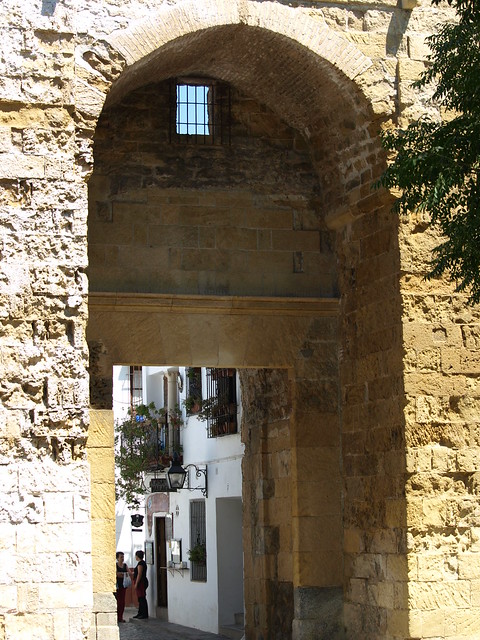
Outside one of the remaining gates of the city, Puerta de Almadovar, stands Seneca. His father, Seneca the Elder, was a philosopher in his own right, but the son became more famous in history. He was a son of Cordoba, later to become an adviser to Nero. In the end he committed suicide after blamed in a conspiracy to kill Nero.


He was a dramatist, considered pioneer of tragic drama and is known to have influenced many including Shakespeare.


AL GAFEQUI


Ibn Muhammad Ibn Aslam Qassoum Gafequi Al- Arab was an eye doctor and an expert in cataract. He is the one I had not heard of at all until I visited Cordoba. His bust is raised opposite to the oldest Hospital in the city and now the Faculty of Arts in the Plaza del Cardenal Salazar .


MAIMONIDES:


Hardly any physician esp in the West has not heard of him. The famous Jewish doctor eventually left Andalus to find his place as the court physician of Saladin (Salahuddin Ayubi) in Egypt. 


His statue, down the street from the synagogue   was the most visited and many were keen to touch his shoes, as the fable goes by that one may get some wisdom rubbing his feet. He is one of the pioneers of the coexistence of science and religion.

IBN RUSH (AVERROES)

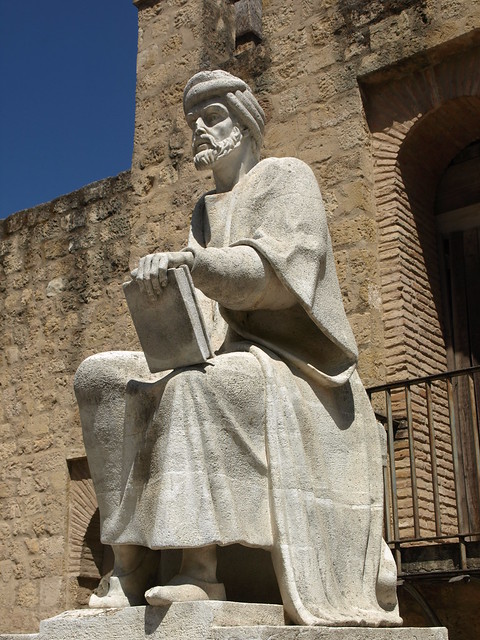
aka Ibne Ruchd Perhaps the most significant son of Cordoba but least recognized. It seems he had no palpable influence on Muslims until recent history.  He preceded Maimonides by a decade. His refutation of the Ghazali doctrine in his masterpiece "Incoherence of the incoherence" تهافت التهافت Tahāfut al-Tahāfut   to Ghazali's "Incoherence" was the source of the thought process which is claimed to influence the renaissance thinkers. His concept that both the secular knowledge and philosophy of the learned elite and the religious beliefs of the masses can lead to truth. He work influenced the fundamentalists Almohads to a degree but eventually he fell from the favor, he was forced to be in exile to Lucena, a Jewish village outside Cordoba. His books were burned. Eventually he was allowed to return but dies soon after that. Apparently he died in Marrakesh, as it says on his statue.

Although he may have been one of the most important link between the older Greek sages and the Modern West, providing his own insight and critique, not only on the works but also on the interpretations of Ghalazi and Ibne Sina, he was almost forgotten in his own Muslim world. The interest in him is a recent phenomenon. 

Reading more about him one finds that he wrote many a time three versions of his commentaries on the same work, the summary is jami,  the abridged version is takhlees  and the complete dissertation is tafseer. 


Whereas Maimonides was constantly surrounded by visitors, I found Ibn Rushd alone in the sun out side the city wall. He was NOT in the tour we had, and I had to look for him. 


The Arabic Inscription:


http://www.flickr.com/photos/nasirgondal/7981483975/sizes/z/in/set-72157631523956456/


MONUMENT TO LOVERS:
http://www.flickr.com/photos/nasirgondal/7981435963/in/set-72157631523956456/

There are many stories and fables about Alhambra, and who knows what is fact and what is fiction, but here in Cordoba, there is a monument to a real love story in the days of Muslim Andalusia. 


It is a love story between two young members of aristocracy, One being a princess. So what happens happened and the two hands remained within touching distance from each other.

In loving memory to their affair are these two hands, one of a man and another of a woman. They are close to each other, but not really touching each other. This is to eternalize the memory of Ibn Zaytoon and Princess Valida. They both were poets and wrote passionately to each other. Things happened and someone else eventually stole the heart of Princess leaving ibne Zaytoon heartbroken.


In memory of this love lost, we read the marble plaque of this innocent love
Oh, how close we were and how far today!
We separated the lot, and no dew
to moisten, parched with desire,
burning my insides, but instead,
crying my eyes are saturated.
I have my eyes jealous of me all,
of yourself, your time and place,
Even engraved you in my eyes,
My jealousy never cease ...


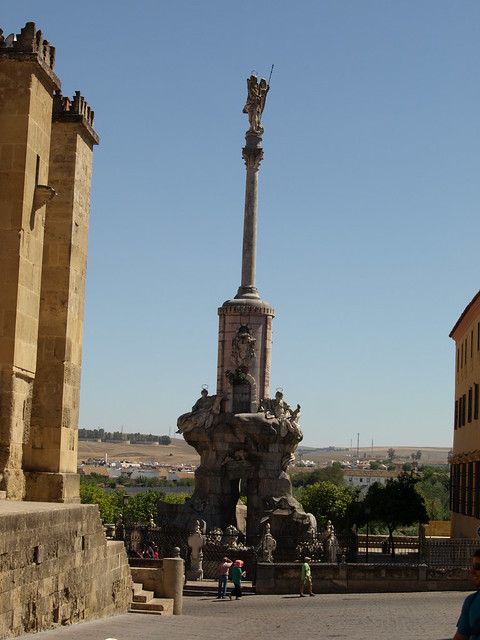
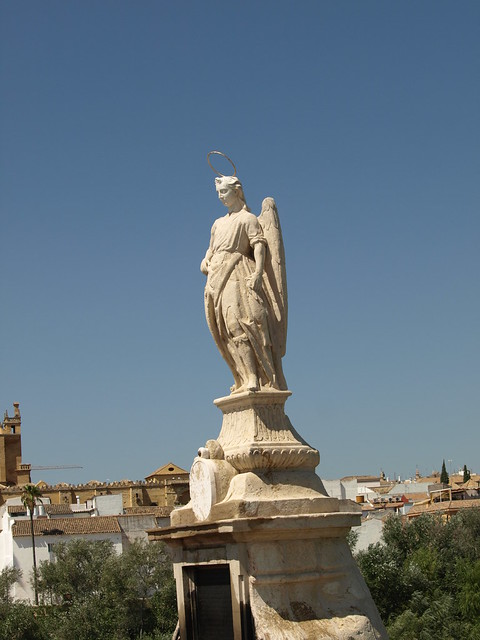
ARCHANGEL SAN RAFAEL
And in the end it is the Soor e Israfeel.

Hazrat Israfeel Alehe Salaam


I have no idea that San Rafael is standing guard at the Roman Bridge which connects the city to the southern suburbia.

Next, Masjid e Qurtuba
______________________________________
Refenence:
http://cordobapedia.wikanda.es/wiki/Mohamed_Al-Gafequi
http://www.iep.utm.edu/ibnrushd/
http://cordobapedia.wikanda.es/wiki/Monumento_a_Los_Amantes

Sunday, January 6, 2013

Cordova, Once There Was


For slideshow click here.

Lying within the wrap of  alwadi alKabir the river, is the pearl of Cordova. The seat of the power, knowledge, wisdom, and wealth of Muslim Andalusia. Where sages pondered, poets wrote, nightingales sang, and beauty walked.

While Granada was the second lease on Muslim rule in Spain, the zenith of Moors and Islamic Spain was Cordoba. This was the center of Muslim Spain.  It was here that the Berbers captured in 711 and made a provincial capital of the Damascene Ummayad Caliphate in 716. Later when the Banu Abbas massacred the Bani Ummaya,  the lone survivor, Abdur Rahman I escaped to al Andalus. He founded the Emirate of Andalusia, Amarat-al Andalusia in 766. Much later, when there was a threat of Fatimid invasion of the Iberian peninsula the Ummayads declared a separate caliphate of their own Khilafatul Qurtuba, under Abdur Rahman III in 929. Perhaps this was the first and only time when the world had three caliphates, Abbasi, Fatimi and Ummayah. It was perhaps the second time that an Umayyad  declared a parallel caliphate in the presence of an existing Banu Hashim caliphate. First one would be Amir Muawiyah.

One of the seven gates of Cordoba, Puerto de Almodavar


The rule of Bani Ummayah (the Emirate and Caliphate combined) lasted for three centuries. As usual, the downfall of the Banu Ummayah was none other than the infighting and the futile wars of succession.  In 1031, the caliphate denigrated into several city states taifas.  The warring taifas, under threat of a Christian invasion, asked their co-coreligionists in Marrakesh, the al Murabitun, Almoravids for intervention, who complied. They were face covering puritanics,  the most famous being Yusuf Bin Tashfeen. He reestablished the formal relationship with Baghdad calling the Caliph Amirul Momeneen  he chose for himself the title of Amir ul Muslemeen.  He lived for more than a century. His successors were succeeded by even more conservative al Muwwahids, Almohads. For reasons un-researched by me, they moved the capital away from Cordoba to Seville.  Decisively defeated in 1212 by a coalition of Catholic kingdoms the Almohads retreated to North Africa leaving al Andalus to feeble taifas to defend for themselves. Qurtuba finally succumbed to the Catholics in 1236. After its fall to the La Reconquesta  the city slowly lost its name, fame and population. It got reduced to become and still remains a small provincial city. Although from time to time it has tried to be the political or cultural capital of European Union.

Cordoba was the worlds most populous city at the turn of the first millennium with the population around half a million at that time. After Baghdad, which had a population of about a million (much later in 1258) when it fell to the Mongols, Cordoba was perhaps the most glorious Muslim capital in its history which fell to the Infidels.  (Delhi was about a hundred thousand in 1857)

No matter what the revisionist historians claim about the pre-Islamic legacy of Cordoba, the golden age of Cordoba was under Muslims. Similarly, the pinnacle of Muslim rule in Andalusia was none other than Cordoba.

It was here in Cordoba that the Jewish 'Golden Age' flourished. The Umayyads of Cordoba were magnanimous enough to realize the potential of the diversity and used it to their advantage. There was a conducive atmosphere for art and education. Artisans, writers, thinkers and scientists flourished. Jews, and some may claim that the Christians themselves, never had it better under any other rule.  Yes, the Muslims made sure no church tower was higher than the mosque minaar, but the nurturing environment led to the human development space which created the giants like Maimonides and Averroes.

The city is within the curve of the river, al wadi al kabeer,  now known as Guadalquivir River.


We were able to have a full day tour to Cordoba from Seville and back. It was to be on a Wednesday but was cancelled due to an event in the Mosque/Cathedral and we went there on a Friday.

The tour guide was a friendly guy. The tourism industry in general have smelled the roses and mastered the art of providing seemingly objective information to the tourists. They do not hide the atrocities of the Christian rulers and are able to explain and elaborate upon the Moorish rule and culture. In fact this is their main sale item and they do cash it well.

THE THREE NECESSARY STOPS:
Like everywhere in Spain, Cordoba has at least three places to visit. A house of worship which is almost always a  mosque turned into cathedral, a military/royal place in the form of a fort an Alcazar and Juderia, the Jewish quarters repopulated and always a lucrative real estate. It was perhaps their wealth and the lack of a security guarantee through Moors (after the fall of Granada in 1492) which made it very tempting to throw them out and have their property and houses seized.

ALCAZAR:


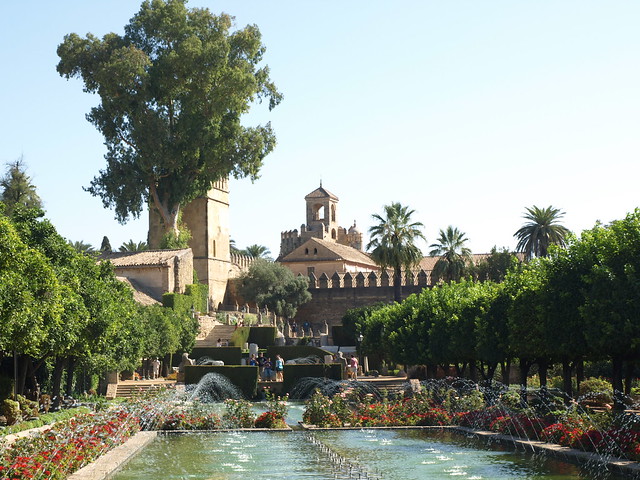
The Alcazar in Cordoba is now a beautiful garden with long rows of flowers and hedges, and the monuments.

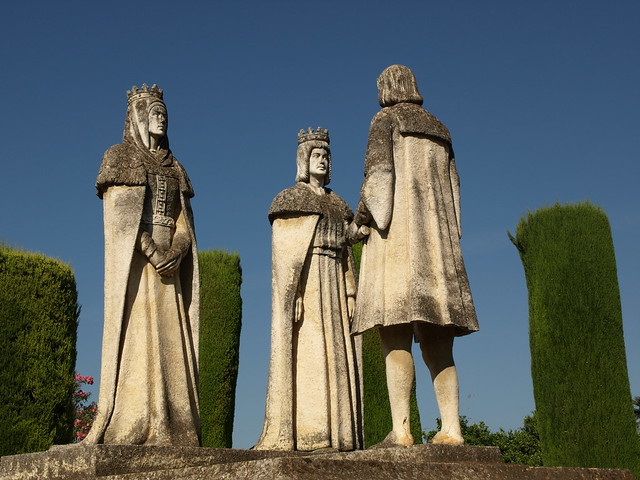
There is perhaps no place in Spain without a mention of Christopher Columbus and the Christian Monarchs, Isabella and Ferdinand. Cordoba is no exception. A monument in the Alcazar reminds us that out of many conversations Columbus held with the monarchs pleading to have a trans Atlantic voyage sponsored,  one was in Cordoba.


Cordoba has another important connection with the New World. It was the money of the expelled Jews of Cordoba, confiscated in 1492 after the fall of Granada the same year, which  made the Columbus voyage sponsorable. As per our guide, the Discovery of America is much more indebted to the loss of coexistence in Spain that we much think of.


SPANISH INQUISITION:

This was the Spain's Catholic Monarch's response to the diversity they inherited from the Muslim. In certain areas the Jews and Muslims were already ordered to convert and there were suspicions that the convertees ie the  conversos  were secretly harboring their original faith. So these summary courts were held, where the confessions were obtained, usually by torture and force, and people were summarily punished. Many ended up in being killed or burned alive. One of the areas of Alczar was allocated for Inquisition. Now it is converted into a church and a museum, where some old Roman relics are displayed.


______________________________________


PATIOS OF CORDOBA:
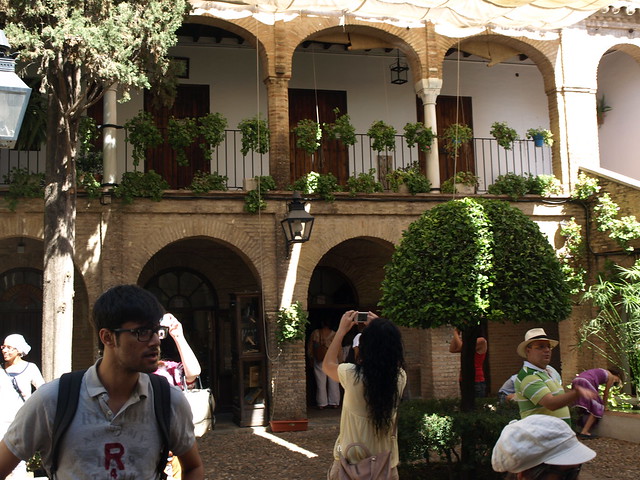
The patio rooms and windows of Cordoba are famous for their elaborate decoration. A custom adopted from Moors, who had a habit of having a small garden within the courtyard, as a constant reminder of Paradise, the Cordobans vie with each other to excel in the annual competition they have in spring.


THE SYNAGOGUE  LA SINAGOGA:


Built during the Christian era, this is a unique example of changing time. After the fall of Muslim Cordoba in 1236 and the eventual expulsion of Jews in 1492, their stay in the city was a mixed bag. In the later part of Muslim rule under the Almohads the life of Jewry was difficult and many including Maimonides fled, The Christians rule brought with it some tolerance for Jews and they were welcomed for their financial resources. It was in that time that the synagogue was built. Its work is essentially Moorish, done by the Mudejar (Muslim artisans) and has four walls of work. Later, when the intolerance led to their forced conversion and ultimate expulsion, this was converted to a church and one sees the Cross over the Star of David.


ANDALUSIAN HORSES:

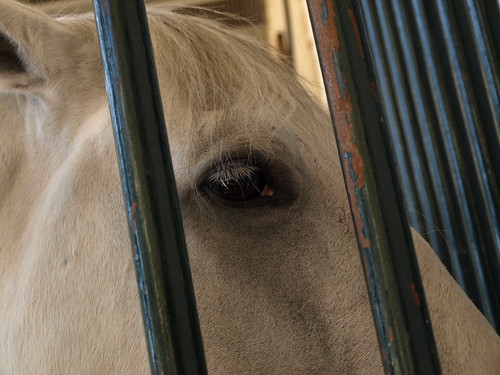
Cordoban horses are also known as Pure Spanish Horse. They are different from the Arabian horses, a bit stocky, compact and thick maned. America was conquered by Spaniards on these horses. The Native American thought of the man mounted on the horse as one big scary creature and were awed by them.


Next, the Sages and Lovers of Cordoba, and then The Masjid-e-Qurtuba


-----------------------------------------------------------------------------
Reference:
Rick Steve's Spain 2012
http://geography.about.com/library/weekly/aa011201a.htm
http://www.ghadar.in/gjh_html/index.php?q=node/35
http://en.wikipedia.org/wiki/Spanish_Inquisition
http://imh.org/history-of-the-horse/breeds-of-the-world-by-continent/europe/andalusian.html

Monday, December 31, 2012

The Legends of Alhambra


"Give him a coin, women, for there is nothing worse in this life than to be blind in Granada.'


http://www.flickr.com/photos/nasirgondal/sets/72157631361023114/


Two days from now, on January the 2nd, will be the five hundred and twenty first anniversary of the Fall of Granada. On this day in 1492, Abdullah Mohammad the Twelfth,  Boabdil left the city as the last ruler of Muslim Spain. 

Granada it is, the ultimate tourist attraction in Spain. More than eight thousand tourists a day, and unless you have bought the ticket months in advance, you cannot see the Nasrid Palace. Yes it is the  Nasrid Palace we mean when we say and speak of Alhambra. Not so big in size; in fact not big at all. 

The beauty of Alhambra is not the size, on the contrary it is the economy of space. Moors knew they have not much space on the mountain top to make it big. The geometric illusions make it look a lot bigger than what it is.


And the water. "Alhambra is decorated with water: standing still, cascading, masking secret conversations, and drip-dropping playfully". 


Spaniards were and still are fascinated by the legacy of Moors. They were believed to have power of the occult. There are stories of hidden treasures left by Moors with spell cast so that once the Moors come back, they can reclaim them. It is more or less what we grew up listening to the stories of hidden treasure buried somewhere in the houses and havelis Hindus left. It is perhaps the psychological impact of a race whom one always has apprehensions about and one builds myths about their unnatural powers and undue advantages.


All this is expressed the many tales and fables about Alhambra and its surroundings. Spaniards were really 'enchanted' by the beauty and the charm of the palace. They had to believe something magical about it. There are numerous tales, well archived by Washington Irving and the like, in Arabian Night style, about the Moors hiding in the caves,  for centuries only waiting for the right time to strike back.


Most of these tales conveniently describe Moors as cunning and evil magicians, their women beautiful and wide eyed. They usually end with the victory of the good (Christians) over the evil (Moors). These are all fascinating stories and Irving has masterly narrated them.

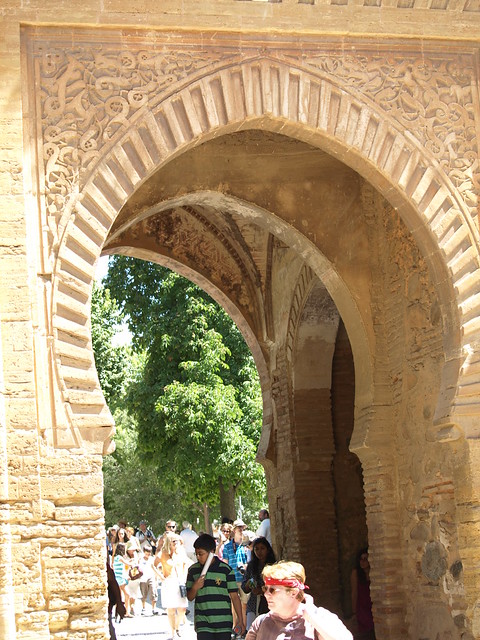
There is a story of an astrologer Ibrahim ibn Abu Ayub, son of Abu Ayub Ansari, who mastered the art of living for ever, but only in his old age, so he has to live for ever as an old man.. He travels to Granada, then ruled by Tariq Bin Zayad's lieutenant Abu Hazen. The astrologer helps the king through magic to foresee  the enemies and defeat them preemptively. Eventually the twain end up fighting with each other over a Christian princess and Ibrahim claims the prize by putting a spell on the princess and taking her along with him under the Gate of Justice. They will remain there until the hand carved in the Gate of Justice reaches the key inscribed into it. see below 

Then there is the almost Saiful Malook  like story of Prince Ahmed Kamal who is kept away from women right from the early life by his father as he was told that he will fall in love really badly. Kept in the tower of Generalife Gardens, he is told about love by a bird in love, a dove. He comes to know of a Christian princess Aldegonda in a far away land and is smitten with the unseen love. Then with the help of a wise Owl and a conniving Parrot he runs away and finds his way to Seville, Cordoba and ultimately to Toledo where he wins the hand of the princess in a Soyember like feast. King, the father of the princess, does not agree and Ahmed Kama runs away on a magical flying carpet attributed to the King of Kings, the fabled King Solomon. It all ends well when the king finds out on reaching Granada in revengeful pursuit that his daughter is now the sultana of Granada.

Then there is the story of Zayda, Zorayda, and Zorahayda, the three daughters of Al Hayzari, the Left Handed king of Granada. Their mother was a Christan princess who died soon after giving birth to the triplets. Al Hayzari was forewarned by sages that something will happen, so he kept them away from public eye as they grew up. The overprotective father was unaware that his daughters fell  in love with three Castillian princes who were prisoners in Granada. In the end the girls plan to run away, by climbing down a rope out of the palace. The youngest one falters and is left behind. Her her soul still haunts the palace, until a Christian comes to rescue her and relive her desperate spirit from the eternal mourning. It is eventually done by a girl who is a descendant of the same prince who were to marry Zorahayda.

Then there are stories of ordinary men finding hidden treasures in Alhambra after striking a lucky charm here and there.

These stories inspired the treasure hunters to find and dig in various places; none has been found so far, except what I consider as the gold mine, mentioned in the end of this post.

Walking through the rooms of Alhambra, one is constantly reminded of these fables which only a century ago may have seemed almost real.

The Alhambra Palace can be divided into three sections. if not four. The tour really takes you through in that sequence. You enter by the outer quarter where the common man was heard for any complaints or official business, the second is the place where the royals met the royal and elite guests, and the last is the private quarter area, which leads to the fourth section, the private gardens.


GATE OF JUSTICE:
It is where the entrance to Alhambra was from the old fort. It is mounted by a dome with has the shape of a hand on one side and a key inscribed on the other side. There is a story that once the hand reaches the key, the treasures of Granada will be revealed.


MEXUAR: As the main entrance of Alhambra is closed by the ill fated decision of Charles V when he chose that spot for his personal palace, now one has to enter through the side door ie the Maxuar.


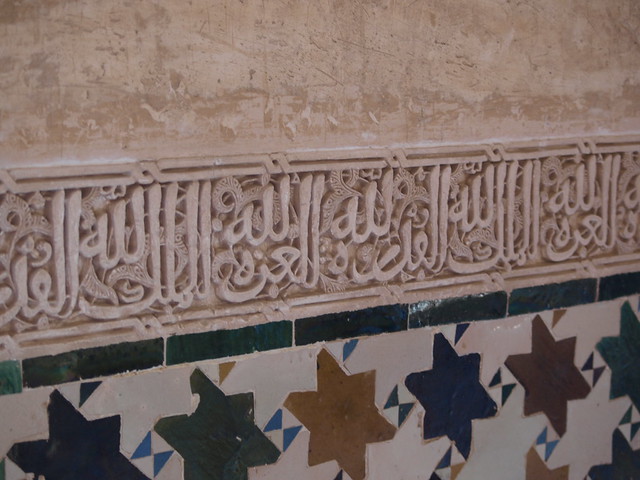
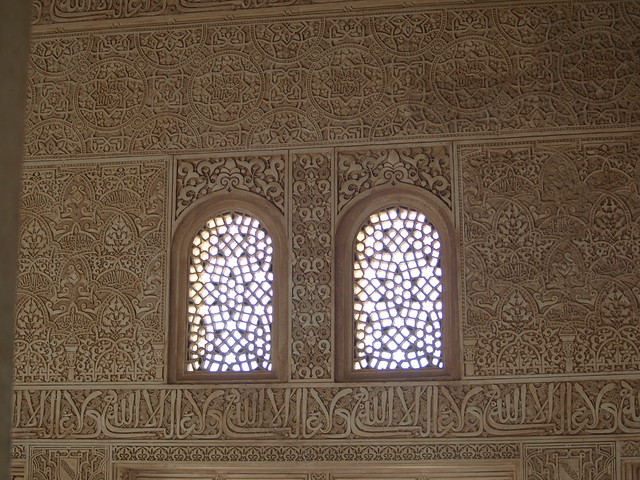
It has some christian influences, but you start seeing what you will see for the next three to four hours. Endless geometric mosaics, wood ceilings, stucco 'stalactites"  ceramic tiles, molded-plaster walls, and filigree windows. The hallmark is the nine thousand plus times repeated phrase of Wa La Ghaliba illala. 


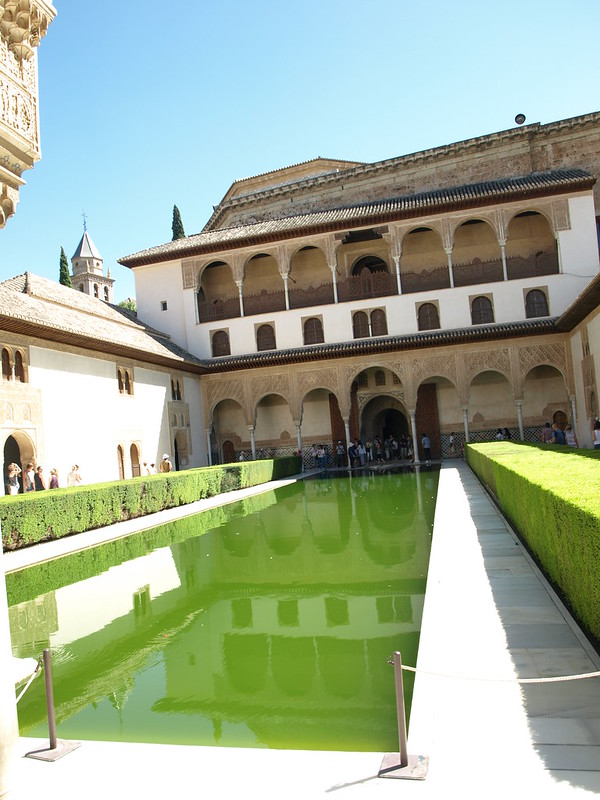
COURTYARD OF THE MYRTLES:The Maxuar leads into a small courtyard which through the side door takes you to the most picturesque place, the Courtyard of Myrtles. The still pond with the reflection of the palace in it, doubles the dimension. 


BARAKA ROOM:

In fact it is Baraka  room ie for the divine blessing, but as in Spanish the work barka means ship, it is now called the Ship Room. It's ceiling is like an upside down hull shape , so the name ship. 


GRAND HALL OF THE AMBASSADORS:

The main room is the Hall of the Ambassadors. It is here the King would greet the guests. The way it is placed, high up in the palace, the guest would have a magnified impression of the size of the room and its grandeur. Through the windows in the walls, one can see the deep valley down. It is this room where the last Muslim king Abdullah "Boabdil" signed the Granada treaty, closing the last chapter of Muslim rule in Spain.


COURTYARD OF THE LOINS:
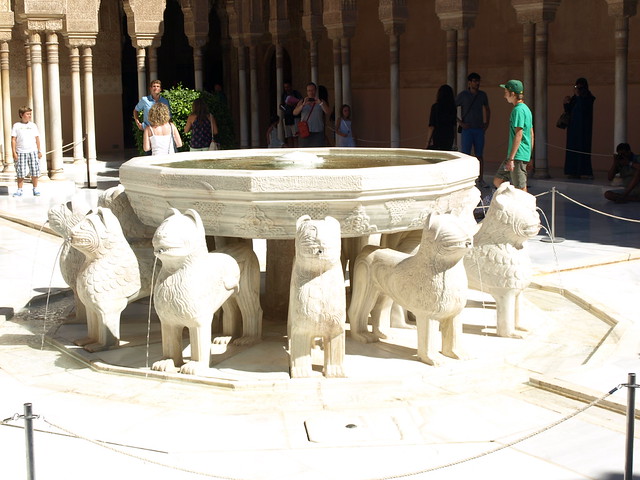
Through the other end of the Myrtles one enter into the private quarters. Here is the fabled Courtyard of Loins. It is one of the wonders of the Palace. It is fabled that the fountain was a gift by Jewish subjects to the King. It has twelve loins, perhaps depicting the twelve months of the year or the twelve Jewish tribes. At each hour the water would flow out of the mouth of one loin. When the catholic monarchs took over, they dismantled the fountain to find out the way it works. They never figured it out and could not reassemble it again. There has been various theories about how it worked but no one can found it out. Now after a long while the fountain is working under a new engineering plan, but it is still not clear if it is the original way.


There is a section in the palace detailing the UNESCO research about the fountain and the various theories about how it worked.


It is the courtyard of the Loins where the most of the Pakistani movie Gharnata is set. It leads into the Hall of two sisters, a cool place for the Harem members to rest. On the other side is the Hall of Abbercerrages where it is famed that one of the king killed many members of the family to get the line of succession to the other wife's children.

THE WALL POETRY:


Perhaps there never was a monument more characteristic of an age and people than the Alhambra; a rugged fortress without, a voluptuous palace within; war frowning from its battlements; poetry breathing throughout the fairy architecture of its halls.


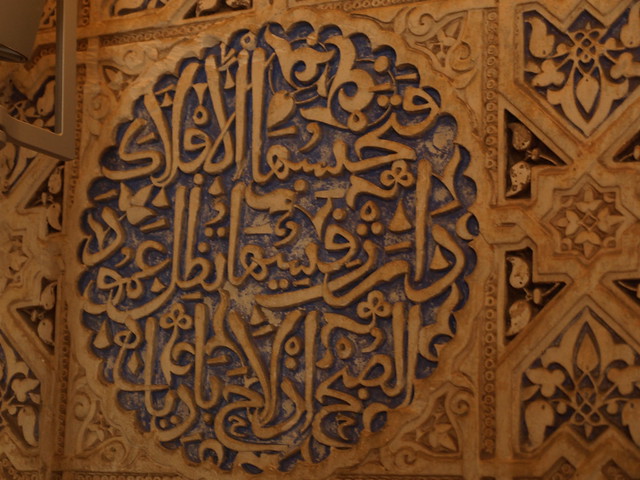
Most of the inscription is all poetry. The poems are as if the walls of the palace are talking to the visitor and describing the atmosphere. Mostly praising the king.


All these charms and stories of hidden treasures of Alhambra seems to be realized now by the Spaniards of today. The amount of revenue generated by the relics of Moors all over the Spain, and specially in Alhambra tells me that the hidden treasures have been revealed and Spaniards for generations to come will reap the benefits of the infidel Moors they successfully and ruthlessly drove away from a land they called home for almost eight centuries. 

--------------------------------------------------------------
References:


Sunday, December 23, 2012

Rituals of Bereavement


As the time is catching up on us, we hear of death more often than before. It is either someone we know or a close one of someone we know. I am used to condolences. It is a part of my business dealing with cancer. In our office one death is often a premonition of another two. They usually leave us three at a time.

Even then, when in the last month I attended six mournful gatherings, it was more than a fare share, all things considered. 

First there was the demise of Dr Riaz Chaudhary's (Pulmonologist) mother-in-law. She passed away in Baltimore and buried in Upstate NY. We drove to Newburgh for a fatiha and qurankhwani. 

Weeks later mother of Dr Shaukat Hussain (Neurologist) suddenly died in Long Island. Janaza was at Masjid Hamza in Valley Stream. He was kind enough to take care of my dying father eighteen years back. His son, a medical student is one of the Huffaz who lead the taraweeh  prayers at ICLI. 

Weeks later Dr Abdul Majeed's (Pulmonologist) sister died after a prolonged illness. She was like on of the sisters many of us have who took care of you when you arrived in a strange land and took you into their arms. Janaza was at ICLI Long Island. 

Within a week was the death of Abdul Hamid's (Shaheen Sweets) wife, Janaza was at Bait uz Zafar

Then the mother of Dr Iqbal Jangda (psychiatrist) passed away in Karachi. He flew to Pakistan, stayed there for one and a half days to attend the soyem and came back to have quran khwani at ICLI. 

Lastly mother of Dr Askari Jaffry (Internist) Risalat Fatima passed away in Connecticut. Janaza and quran khawani was at Khoi Center in Jamaica, NY. Askari is the youngest of the brothers. All very active in the community from Westchester to Connecticut. His elder brother Shaukat Jaffri is  known to many. Askari is Zoha's class mate from Dow and is married to the daughter of a close family friend of ours, Dr Nasir Zaidi. 

These deaths and their related events or rituals took me to peoples homes and their houses of worships. I went to three different mosques, sunni, ahmadi and shia. Although the basic ingredient of a mournful gathering is recitation of Quran in some form or another, people do other rituals in different ways. The most engaging and riveting one was the celebration of death at the Khoi Center. It was the soyem event, started with recitation of Quran by participants. Then there was the prayers, maghrabain. Striking difference in communal prayer was that the Imam said the whole prayers loudly, including the sentences and phrases during prostration and sitting, but did stay silent during the qayyam of the last two rakats. 

After the prayers, there was a sitting session, which started with the recitation of Chapter Yaseen and then a prayer for the deceased. 

And then there was poetry. The whole session was devoted to the subject of motherhood. Four poets recited their poetry in Urdu. It was quite touching, given the relevance of the occasion. It was followed by salaam and a speech by an orator. 

Shia's recipe of grief management is to overlap the grief at hand with the tragedy of Karbala. It helps one express grief profusely and thus it becomes therapeutic. 

All these six deaths I mention were of individuals who had lived a full and rich life. They had seen their near and dear ones grow up and be successful in their own right. Deaths are to be mourned and that is what we do to help each other go through these tough times. But the pain of these deaths to their survivors pale in comparison the massacre of elementary school children in Connecticut. Those nascent lives, full of dreams and hopes were mercilessly and senselessly cut short.

It was during one of the dirges of Karbala when the slaughter of children was lamented that I could make the connection with the death of innocence in Newtown Connecticut. I could not stop being teary eyed. 

Rituals is not a bad word after all.


Oh Lord!
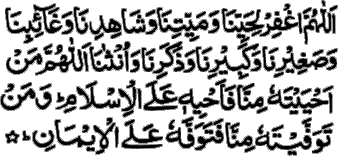
Let be forgiven the Alive and the Deceased
The Present and the Absent
The Young and the Adults
The Men and the Women.
Let the Living live at Peace
And the Dying die with Faith

Friday, December 14, 2012

Prayers In An Ahmadi Mosque


Unless one came to the United States in the last five years, it is hard to think that one does not know about Shaheen Sweets. It started as a small shop in Lexington Avenue in Manhattan in 1973. Then it had an exponential rise. By the time I came here in 1988, it was almost on its zenith. There was a sweet factory on Broadway in Jackson Heights, along with another restaurant in the area and the sweets were shipped all across the USA and Canada. Once I was in LA in an Indian grocery store and the only mithaee was of Shaheen. Later it had a slow decline when many competitions arrived, both Pakistani and Indian, and later Bangla Deshi. Now the Manhattan restaurant is gone, one in Jackson Heights is closed and the other is only a sideshow of sweets with the main food service by Dera restaurant. The founder, Abdul Hamid had retired and the sons presumably went their own ways. One moved to Baltimore. One grandson Zeeshan, opened a shop in Hicksville Long Island. That is close to our home and if food at our home is catered from outside, most of the time it is from there.

On Dec 11th, Naseer Sahib, the lifetime loyal of Shaheen informed me about the passing away of Zeeshan's grandmother and of the funeral the day after next, in the middle of the day,  I made necessary arrangements to be there.

So on December the 13th, I entered an Ahmadi place of worship for the first time in my life. Growing up we always had Ahmadi friends. Many a time due to my father's liberal interaction with anyone who was interested in talking, we had Ahamdi enthusiasts working overtime to convert him. I think he visited Qadian a few times in his early life. I grew up reading left over copies of Al Fazl newspaper all the times. But I never went to an Ahmadi mosque until now. 

Sometime during the gradual tightening of the noose on Ahmadi way of life in Gen Zia's time they were disallowed to use the word Masjid for their places of worship. So all of their  masajid were renamed as Bait. Perhaps they got so much used to it that they now call the masjid here in NY as bait; perhaps a way to distinguish themselves.

I had seen the place from outside all the times. It is on my way home. A friend of mine had told me months back that Ahmadis have bought a big place just off the Grand Central Parkway on 188th street. It is named Bait uz Zafar, named after the first Foreign Minister of Pakistan. Apart from being the most famous Ahmadi in Pakistan Movement, he has other claims to have a place of worship named after him. He has translated Quran in English and it a pretty good translation.

It is a converted place, perhaps a school or a church. Quite spacious for NY, and in the middle of a thriving neighborhood. A very prominent place. The entrance is very visitor friendly and has information on the Ahmadi creed on the walls. The display is pretty impressive with many translations of Quran by Ahmadis in various languages. The main hall is a divided auditorium, front for men and rear for women. 

It seems like that Ahmadis have more of an emphasis to have the head covered, for men. Not that much emphasis on the beard, however. Most of the bearded persons have beard like me, less than half an inch. I remember in old days it was called the  ahmadi dhaari.  People of recognized responsibility don the qaraquli cap, and most of the rest have some sort of a head gear. The pictures of all the leaders in the hallway had either qaraquli caps or the turbans, once make popular by their founder. I remember Dr Abdus Salam wearing that type of turban when accepting the Nobel prize.

The actual funeral was preceded by Zuhr Prayers. The azaan was the same as what I had heard all my life. Not that much emphasis on the melody of recitation. The imam who led the prayer was a traveler and led the prayer in the familiar way. All the rituals were like I have grown up with. In fact some of the other sects have somewhat different rituals and one is sometimes not sure how to follow, but not here. Most of the nonahmadi's like me prayed behind the imam. expect a few. Many of us Non Ahmadis were either trying to establish an eye contact with each other or actively trying to avoid that. In the end most of us did blend in. 

Imam had informed the congregation that he was a traveler and he will only pray for two rakats and the locals should continue the rest of the prayer on their own. That is the way it happens all the times. Somehow most of the congregation did finish the prayer with him, and joined him again for the two kasr for Asar prayers. Perhaps most were travelers like the Imam. 

The janaza prayer was also exactly the same as the sunni prayer. Although it is silent, but the Imam was mouthing the words in a big whisper ( as sometimes they do to guide the congregation on what to recite) and it was of the same sequence ie subhanakallahuma/darood/allahuma agfir-- and without the alhamd.

There was however no communal prayer at the end of the namaz or the janaza, like raising hands and offering supplications. 

Noticeable exception was that the women did not line up for the janaza. It may not be a creed thing. and perhaps the culture of a particular mosque. In our masjid  at ICLI, women do line up for funeral, if they desire so.

All things considered, it was not much different than any other funeral I attend. Somehow funerals and memorials have increasingly become a part of social calender, perhaps a factor of our age as a community. Going in I had cautious skepticism, coming out I felt somewhat good about being there.

Somehow I felt writing about it.