Monday, November 12, 2018

Happy Hundredth! Abbaji


My father, Chaudhry Mohammad Aslam, would have been hundred years old today. Born on the day after Armistice, he grew up in British India, got married on the first anniversary of Pakistan’s independence, lived almost all his life in Punjab and died in New York two days after his 74’s birthday.

Much of his life amazes me; he is my example of simple and contended living.

He lived an ordinary life. He was youngest of three boys. His father was the first to leave the village, matriculate and get employed in Army Medical Corps.  Hailing from Dhok Mohka (short of Mohkumdin), a hamlet south of Rohtas Fort in District Jhelum, he spent most of his professional life in Rawalpindi and Murree. My father’s childhood was spent in those cities. He grew up in Committee Chowk on the Murree Road.

His elder brothers went on to get Masters in their respective fields and retired at the peak of their professions. In this upwardly mobile family, my father was not an ambitious man at all. He studied in Denny’s School and Gordon College, and then is Islamia College Lahore for a short time, he got a job in Military Accounts after he graduated.

He felt happy doing routine office work, and not compelled enough to move up the ladder. He preferred to live in small towns and felt uncomfortable when he was posted for some time in the metropolis city of Karachi. He appealed to be moved back to small town.

He had simple pleasures. He liked to read and visit places. He had been to every shrine I could think of: from Bari Imam to Zinda Pir ( Ghamkol Sharif) to  Bahishti Darwaza in Pakpattan. He had been to Qadyaan a few times. He enjoyed the melas (Fairs) and political gatherings. He had been in Lahore on the day of Lahore Resolution.

He was a modern man, in many ways. His wife, my mother, was the first one in his family not to cover her head. He took his daughters to watch movies in the cinema houses. Every summer night, he took all the family out for a walk after dinner. He sent his daughters to boarding house at age 15 to Frontier College Peshawar, one after the other, as there was no college in Kohat at that time.

And yes, all this was not in a big city. It is about Kohat in the then North West Frontier Province, in sixties.

In other ways he was very traditional. He kept his fatherly distance almost all his life. It was only in the last few years of his life, here in the USA, that I could talk to him freely on many things; still many, not most. Even at age 70, he would show deference to his elder brother, who was a heavy smoker, and extinguish the lighted cigarette before facing him.  

He always had company, they were mostly entertained at our home. But later in life, when he was living a retired life, he was okay to be alone and spend time reading and watching TV. He enjoyed company but was also happy being alone.

Nothing seemed to bother him. He handled many tough situations without others around him being aware of them. He handled indiscretions on my part with grace.  On some, he did not let me know what he had to suffer due to my doings.  I came to know much later of them.

A product of his time, he was not expressive in his emotions. It showed in his actions. When my mother Maqbool Fatima got sick, and she got increasingly debilitated for the last ten years of her life, my father took care of her as her first and foremost attendant. He made her breakfast, served her tea at her prayer station, gave her medications and when she had extended hospital stays, he stayed with her day and night.

He lived on for five years after my mother passed away.

With my mother, he raised five children, with modest means, and we could not have wished for a better childhood.

Through three daughters and two sons, Fozia, Farida, Bushra, Mubashir and I, my parents have 12 grandkids and four greatgrands.

My sisters are the luckier ones to know the parents more.  My eldest sister Fozia, has been like a third parent to all of us and helped my parents raise the rest of us. My middle sister, Farida, had the privilege to take care of them after they moved to the USA; and the youngest, Bushra, took care of them when they were in Pakistan.

My brother Mubashir and I did not have chance to do our share in taking care of them. They both were in a hurry to leave.

Five years back, at this time, a few lines poured out of my keyboard. I end with them.

https://ghareebkhana.blogspot.com/2015/11/i-miss-you-abbaji.html

May his soul rest in eternal peace.

The more I grow older the more I realize what a guy he was.

Carefree, funny, witty, caring, sensitive and honest.


He was unable to achieve many worldly goals.

In fact he settled for a lot less than what was expected of him by his family.

He was content with what he had. 


What he did not have did not seem to bother him.

Always managed to bring some fruit on daily basis on his way home. 

We always had sweets at home.

Perhaps that is why mother always thought he had more than he actually had.

When mother got sick, he took care of her for a long time, assisting her in all activities of daily life.

She perhaps did not know that he was not that well either.

He never let me know what problems and humiliation he had to go for me for my issues with the authorities.

He made sure all of us siblings knew if either of us were unaware of the expectation of the others.

Worked behind the scenes to keep us together.

He was a good man. 

Wish I had known him more when he was around.


I miss you Abbaji.

Be Well.


Sunday, July 22, 2018

We Come in Peace: MET rooftop display by Huma Bhabha


Source. Press release:  https://www.metmuseum.org/press/exhibitions/2018/huma-bhabha


On July 13th, 2018,  I went to see “We Come in Peace”, the roof top display of a Pakistani American artist Huma Bhabha at the Metropolitan Museum of Art.
Huma is a Pakistani born artist from Karachi, who had studied in USA and settled in NY. Her interview on the display is at the end of this post.

There are two larger than life figures, like aliens occupying the roof of MET. On first glance, one seems god like, standing erect. The face looks like a sphinx and torso has large breasts. The other is prostate, like in sajda, almost in the direction of the standing figure. The face of the prostate figure is hidden in the ground, the whole body covered by what seems like a large black garbage bag. Only the clay-made hands on the ground in the front and a line of excreta in the back, looking like a tail, are evident otherwise.

What seems like one prostrating to the other, gradually look different. They both, it turns out, are expressions of death, suffering, exhausted by defiance, exploitation and being out of this world. They are somehow in this experience together, not one at the expense of the other. 

More on that, later---,

It was part of a tour one take with the artist. The series is called 'Artists on Artworks'. The artist takes you to various artifacts in the museum of her interest. Here Huma took us to four statutes, all influencing her own roof top display. She was accompanied by Shanay Jhaveri, the curator of the display at MET, who gave in depth details of the artifacts and their relationship to Huma's work.  He interviews her in the link at the bottom of this post.


The first one was a marble statue of 6th century BC, It is a standing figure from Attica ,Greece. Influenced by Egyptian art, it is a young slender male figure with one step forward, as he is about to move. He is very symmetrical and face is poised. The statue marks the grave of a young Athenian aristocrat.


The second was a Togu Na female figure from Mali, carved out of wood. Here the bosom is exaggerated perhaps to emphasize the nurturing or the resolute power of a woman. These forked sculptured elements support a roof beam of Togu Na open-sided shelters where elder Dogan males sat and discussed important matters of the community.


The third is a crest Tsesah from Cameroon on Bamileke people. Made of wood, these were the larger than life face masks used at the time of coronation of a new king Fon, when the older one dies. One extraordinary feature of these collection of figures where the eyes are placed on the cheeks facing the heavens in the sky. It was perhaps used in the coronation rites.


The fourth was the bronze 'Head of a Woman', 1909 by Picasso. His signature cubism is displayed in the face. Walking around you realize that each angle gives you a different shape and meaning to the statute. It is claimed to be the likeness of his partner, Fernande Olivier.

And then we went to the roof top and see the work of the artist.

In her own words it is an expression of militarism and exploitation. Seeing these two figures, one erect and the other prostrating, in the backdrop of Central Park and the high-rises of the metropolis beyond that, gives it an out of this world experience; as if you are in a distant place, like a desert, looking at these images and the civilization is at the horizon, too far away.


Looking at these images again, the erect one, named 'We Come in Peace', perhaps taken from the first dialogue between aliens and humans, "We come to you in peace" in "The day the Earth stood still" by Robert Wise, is non-binary, a hermaphrodite, carrying physical manifestations of both genders. They have one step forward, as if in motion. The breasts are enlarged, making it as obvious as another part of the body. The face, in fact five faces, has the typical element of cubism and walking all around, you see the different Picasso influences. It also reminds of the all seeing Vishnu with multiple heads.


The prostate figure, Benaam, Urdu for nameless, perhaps depicts the nameless masses, who are in the process of dying, falling prostate, hands down and excreta is coming out the other end. One could not thing of a worse condition one can be in.

As a viewer one is entitled to derive one own interpretation of art. To me, it was the foreignness and out of place-ness of these two. They may have landed separately but are now here together. Benaam could be the nameless dying in the present day global wars, or could be the undocumented. They may be in a process of dying, but refuse to be invisible. The erect figure is mutilated, violated, but still stands tall and stands with five faces looking all around, as if bearing witness to what has happened and is happening. They brought their sufferings and stories to the house of power. There is a cry to be heard. The reference of the title implies as if these 'aliens' want to have a dialogue, but may still communicate in other ways. Their defiance and refusal to go away with the backdrop of Manhattan skyline, the ultimate symbol of the powerful is very striking. Could not think of a better contrast.

It was a trip worth taking on a Friday evening.


Artist's interview:
https://www.metmuseum.org/metmedia/video/collections/modern/huma-bhabha-roof-garden-interview


Tuesday, June 12, 2018

Visiting Patras Bokhari


June 2nd, 2018

Lot 16368.Section 177, Pocantino I-B-2, near Actors Fund of America. That is where it was. the place I visited 26 years back for the first time

Today I went to visit Patras Bokhari. His final resting place, I mean. It was after a long time. The last time I could not find my way and got lost in the crowd of graves in the Kensico Cemetery.  At that time I was relying on my memory which I thought will lead me straight to the site. I was wrong. So this time I went to the office first.


The first time was in 1992. We had recently moved to Valhalla. I commuted daily through the cemetery to Westchester County Medical Center, where I was doing my heme/onc fellowship.  Kensico Cemetery is very scenic, on the hill and always lush green. On his visit from Pakistan, my father in law had expressed the wish to go to the cemetery. He had read in Dawn an article about Patras Bokhari, It mentioned that he was buried in the Valhalla cemetery. We went to the office, and surprisingly the lady who assisted us remembered the events around this death. He worked in the United Nations as the first permanent representative of Pakistan, and later as the undersecretary general of Information and had died in New York. Some Muslim resident had a burial lot and donated it for his burial. It was a lonely Muslim grave in this non-denominational cemetery.  The tombstone simply told us that Ahmed S, Bokhari was born in Peshawar in 1898 and died in 1958. And then there is a verse from Robert Frost. More on that later, see below.

After that I had visited it many times for the five years I lived in Westchester County. I had taken my father and his elder brother, who  along with Faiz, was a student of Patras at one time. Many in my family and circle of friends visited the grave when they visited us.

Then we moved out and hardly visited the grave as it was out of the way. A few years back on our way back from upstate we tried to visit, but could not find it.

Today, I was in Westchester and was about to go home that I just thought of it. I had time. Why not attempt another visit. And I turned towards the cemetery. In the office a lady was able to locate the record and drew me the way on a map. It seemed to be a different area than I thought. I took the map and went to the graves. I spend one hour in a rather hot day by NY standards but could not find it. The area was mostly ‘inhabited’ by Chinese and Parsis which tombstones in Mandarin and Farsi. I had to go back to the office and they realized that they had sent me to section 77 instead of section 177. Now I did find the grave.

The cemetery is kept well. But the tombstone was a bit out of ink. There was a sign of ‘Extra Care” next to the grave. I spend some time, paid my respects and went back. His death anniversary was, I realized a couple of weeks back.

Growing up, his name was hard to miss. I remember reading his essasys , Patras Kay Mazameen ( Essays of Patras). A few of them were in our Urdu course. Remember one, kal sawary jo meri aankh khuley”.

Hailing from Peshawar, he and his brother made it to Dehli and the All India Radio. I heard a lot about him from my uncle and later learnt from NM Rashid's writings about the way he was as a teacher and an acting instructor. He was a peculiar person.

There is an interview with Prof Anwar Dil. On Patras Bukhari, he had a long association, initially in GC Lahore as his student, later a coworker with him in AIR Dehli and then in UNO in New York. We learn that Patras was very finicky, aloof and a private person. He was a theatre artist and performed often in the reproductions of English plays in GC College. He delved too much into the work of the government to the detriment to his literary life. Rashid thinks that Patras would have left a bigger legacy in literature had he not been a government employee. With Patras, it seems there were similarities although there were differences. Both had Urdu as a second language, both were anglophiles and worked for the government, British India and then Pakistan. Both were what we may label today as elitist.

Kensico Cemetery is home to many famous people. There is a cell phone tour of famous individuals buried there, http://www.kensico.org/cemetery-map/#KenCemMap
http://www.kensico.org/cemetery-map/#KenCemMap
But Patras in not one of stops on the tour. Someone,  perhaps the Pakistan Consulate should look into it.

On his tombstone is a couplet by Robert Frost who  wrote it for Patras. In his letter, posted on the website dedicated to Patras Bokhari, Frost writes on April 19, 1957;

     " Your visit would vibrate in my memory for the rest of my life, though I were never to see you again. I have taken my time with your undeclared request. I wonder if I would be far wrong in figuring it out to be for something like the following couplet--"

And then is the couplet, reproduced on Patras's tombstone as you can see in the picture, 


From Iron Tools and Weapons
To Ahmed S Bokhari
Nature within her inmost self divides
To trouble man with having to take sides 


I wonder what was the undeclared request to which Frost responded by writing a such a deep verse and dedicating it to Patras. It is on page 468 of his complete works, "The Poetry of Robert Frost"
---------------------------------------------------------
References

https://en.wikipedia.org/wiki/Patras_Bokhari


Sunday, May 27, 2018

Leonardo da Vinci by Burno Nardini

Leonardo da Vinci by Bruno Nardini
Portrait of a Master


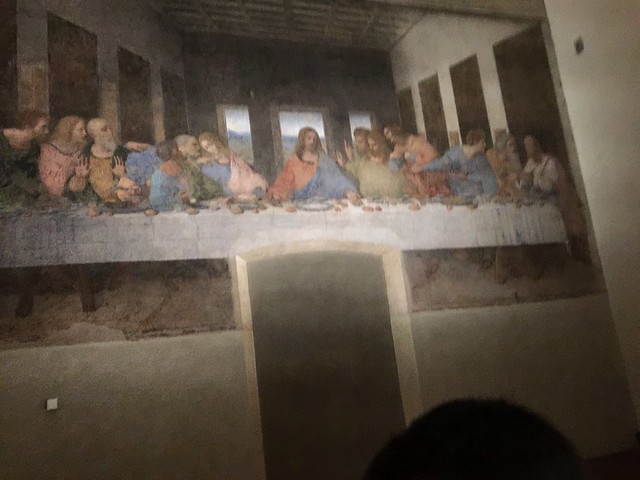
After waiting for a long time going through temperature controlled rooms, when you finally enter the old dining room of the priests in the monastery and look at masterpiece painted on the wall, it is a bit underwhelming. Although restored, the paint is faded and hazy in many areas. One has to look at the other forms of reproduction of "The Last Supper" like the one reproduced below, and to know the history to really appreciate the work. Here the moment is captured when Jesus reveals that one of his disciples will betray him. This painting, and of course, Mona Lisa. are the two by which Leonardo is known to the world. 

I bought the book in March 2016 in the gift shop of monastery of Santa Maria delle Grazie in Milan, where The Last Supper adorns the wall, but it took me more than one year to finish the book.

An excerpt from the book.

Leonardo was a living contradiction. In a century rich in innovatory trends, leaving behind it a vast heritage of art, he impersonated in himself the themes of Humanism and the Renaissance, but also turned his back on that century to gaze far in to the future, anticipating an age still to come- our own, the twenty-first century.

I have a confession to make. I don't know much about Western art despite going to museums for a while. As I was not exposed to this side of art while growing up, it is hard to learn. So the following account is not for those who know art inside out. It is for many like me, as I learn along the way.

We learnt growing up that Renaissance, the "Fire in the Ashes"  took Europe out of dark ages on the path to enlightenment. I did not realize that it was Italy, and Florence to be precise, where it all started. Social and cultural renaissance happened earlier than the later roller coaster of scientific and industrial  innovations and inventions. Even in science, Leonardo and Galileo are connected to Florence and both have a museum to their names in the city.  

It is the emancipation of thoughts which lays the ground work for development in other fields. The concept of Humanism, fore bearer of modern ethics, is perhaps the first step in the 12th to 17th centuries of Renaissance.

Late 1400' were the days when many Greek scholars and others found a conducive environment in Florence, thanks to the trader-rulers Medici who came to power after the fall of Constantinople to the Turks. So in some way, the Muslims indirectly led to the beginning of renaissance

It also meant that the merchants can be good rulers, can promote humanism and an atmosphere of culture and arts.

It was that conducive atmosphere where a young Leonardo, just moving from his town Vinci to Florence to join his father, found himself.

For a beginner like me it is not difficult to get confused between Leonardo and Michelangelo. It was not until I visited Italy and saw first hand that the difference was clear. Leonardo has Mona Lisa and The Last Supper. Michelangelo is the one painted the ceiling of Sistine Chapel in Vatican and sculpted David in Florence.

Both were from Florence, and contemporaries. Leonardo was older. Although known to posterity for his paintings, he was an illiterate who self taught himself and had been an engineer, (conceived the first flying machine), sculptor, anatomist,. inventor of war machines, etc.

His grandfather was a notary of means and had influence in the town of Vinci. Leonardo was a love child, 'illegitimate". His grandfather took control of the situation and had his son, ( Leonardo's father) married somewhere else right away and influenced another person to marry Leonardo's mother. Later his status was legalized. That did not prevent, much later, his eleven or so legitimate siblings to keep him away from their father's inheritance.

He was illiterate by choice. Although son and grandson of notaries, he showed no interest in learning math and other subjects. His father realized that early on and showed his drawing to Verrocchio, an artist, who ran one of the successful workshops in Florence. Those workshops were residency institutions. where the students lived, worked and learnt the trade under the direct supervisor of the master who also acted as a guardian. Verrocchio realized the talent and took the young boy under his wings. Soon the teacher broke his brush when he saw that the pupil had painted an angel better than the master in a pair of angels.

It was in his workshop that Leo got the attention of Lorenzo the Magnificent, the Medici king of Florence, who like his grandfather was a great patron of arts. Much of the Florentine Renaissance is credited to the conducive and nurturing atmosphere of the Medici's. Hard for me to accept, but it seems to be true that the early seeds of what became the fire in the ashes were laid by the lords of feudal system.

That was the time that Renaissance was taking birth in Florence. He had the privilege to be in the companies of great artists, thinkers and philosophers, many had converged to the city from various parts of the world. That is where the early field of Humanism developed.

It helped his imaginations fly and they did fly.

The Medici King. in order to export the talent of Florence around, asked him to go to Milan to help Ludovico il Moro, the Sforza ruler, realize a dream of making a magnificent horse sculpture of his ancestor. Leonardo landed in Milan. After a long delay, as he got easily distracted, he could only make a clay model of it before the French moved in and the Sforzas ran away.

But in the meantime, he was asked to paint the Last Supper on the wall of the mess, the dining room of priests of the church.That turned out to be his classical masterpiece. That is where I bought this book by Bruno Nardini.

He had arranged great shows for the royal wedding where the planets revolved and actors played; a precursor to the mega million shows we seen these days at the opening and closing ceremonies of Olympics.

Sometime in Milan, his birth mother showed up and he took care of her till she died. That was for a brief time. He mentions that in his journals emotionlessly, and not acknowledging her as mother, only by her name, Catelina. He walked alone behind her funeral.

When Milan fell to the French, he moved to Venice and eventually to Florence. Back in Florence he had started to paint the young wife of a Francesco del Giocondo known as  Mona Lisa Gherardini.

Then there are years of wandering along with the General Giuliano with whom he moved to various cities. He was also accomapined by the famous Machiavilli of the "Prince' fame. Later the brother of the general, became the Pope. Like others Leo tried his luck in Rome for a while but was of now avail. Later as a part of a truce between the French King and the Pope, Leonardo was asked to accompany the entourage of Pope. The French King, Francis I, at that time was already impressed by Leonardo and asked Pope for Leonardo, Pope agreed and Leonardo moved to France to pass the last days of his life. He had to do nothing, just provide company to the King from time to time.

It is there in France that he died and was buried.

A life well spent is long.

He was particularly religious and doubted the doubts of agnostics. He thought both the believers and atheists were ignorant and much has to be learnt before one can make a determination. He however did think there was a Prime Mover.

He had no clear relationship with women. He was once accused of sodomy by an anonymous complaint. Charges could not be proven, and his father was helpful in getting him out of trouble. That episode left a mark on him and perhaps he became even more private in his personal affairs.

There were at least two pupils with whom he may have had romantic relationship, it could have been platonic. One of them, Salali, who inherited Mona Lisa portrait, may have been a muse of some of his works. Salali was a young arrogant, vivacious man whom Lenoardo had a sudden liking of. That was despite the fact that he stole from Leo and his friends all the times. Leonardo tolerated him all along; except in the end of his life, when he went to live as a guest of the King of France, that he did not take him along. Salali may have refused to go, as he realized that now another pupil, son of a Count Melzi was now the favorite of the Master.

Other realized that primarlily he was a painter, but he wanted to be much more than that. He had ventured into the fields: anatomy, (dissected the human body twice to know for sure how it is), engineer, inventor, sculptor. and much more.

He had a habit of documenting everything. His notes, recently discovered, provide much information on his attention to details. He took in things slow and was habitually late for things. That is why many of his works remained unfinished, One can imagine how much the world would have inherited had he been not as laid back as he was.

There is an interesting story about the story of a shield which he make out of a log, It was given to his father by a peasant. Leonardo painted a speculator demon on it which would put the viewer in awe. His father was impressed by it and realized the peasant was not worth getting it. He bought a cheap painting from the market at gave it to the peasant and sold the original painting of Leonardo at a much bigger prize. It showed the difference between a worldly father and an artist who was happy that he made his father feel scared at the first sight of the demon painting. That was a prize worth his work and he needed nothing more than that.

He had two prophetic dreams. One was that he saw a flying kite, It was a memory of infancy, that while lying in a cradle, a kite came down and opened his mouth with its tail and struck him many times with its tail between his lips. Full of symbolism.

Second was near the end of life. Breathing heavily, were his last words. " Yes, now I remember. I wanted to say that everything we know begins from feelings. Now I feel myself flowing away like the water in the rivers. I feel myself borne by the currents towards death. Now I am going to live it, to experience it."


Thursday, May 17, 2018

Mirage of Power, by Mubashir Hasan


`


I finally finished reading Mirage of Power by Mubashir Hasan.  I was searching Shahrah-e-Inqilaab, a book of his, which I read as a young man as a part of a study circle during my medical college days.  That book had helped open up new windows of my mind and helped me understand history in a new light. Now I wanted to read it again and could not find it. In the process, I found this book on amazon.com so I bought it.

This book is a collection of memories by MH about the time Z.A. Bhutto was in power, from the fall of Dhaka to the military coup and then his execution. 

I had hoped this book will offer a closer look at the inner workings and the thought process of Bhutto in all those years. I got some of that but not much. Perhaps Mubashir Hasan was not that close to ZAB and hence you see the view from a distance all along. He does not tell the inner stories of important decisions; like why he sacked the provincial governments of foes and friends, why he sacked JA Rahim, why he decided to hold the elections early or late etc. It seems that while MH was not close to Bhutto, he still wanted MH to be by his side. He wanted MH to deliver on some promises he made in his manifesto, and wanted to keep feudals in check by having a leftist by his side. But MH was outside of the inner circle. Despite that he remained a loyalist and a bit meek one at that. He fails to be critical of ZAB on any decision of importance.

Regardless of that, it brought me back to the days of my youth and the names I saw as headlines on newspapers, heard on the radio and seen on the PTV screen all the times. Some pieces of information, mentioned below, were either new to me or I have already forgotten.

Preface:
In the preface he tells of the group of young enthusiasts in Lahore who formed a study circle after the 65 war. They were in thirties and early forties and were from different walks of lives: poets, lawyers, principal of a girl’s college, architects and engineers. They wanted to see a progressive change in the country with a leftist manifesto. At the same time ZAB and JA Rahim had decided to make a new political party and approached this group which included MH. Bhutto and JA Rahim agreed to adopt their manifesto , “ A Declaration of the Unity of the People”. They joined en bloc. He does not mention the names of others in his group. On November 30th and Dec 1st  1967 a convention was held in the lawn of Mubashir Hasan’s house, and PPP was formed.

Chapter 1: The Dramatic Takeover
First cabinet was very democratic. Besides Jatoi there were no big land lords.
Bhutto attitude changed and slowly he started to adhere  to and perhaps enjoy the privilege of protocol. It started to create and increase distance between him and his close associates.

Chapter 2: State of the Nation
MH became the finance minister. Had no experience of finance.

Chapter 3:Meeting the Challenges I
Soon after taking over, the idea was to achieve as much as you can to fulfill the manifesto. Much was achieved even before the interim constitution was formed.
In 1972 there were nationalizations of electricity, land reforms, and banking reforms were planned.

Chapter 4: Meeting the Challenges II
Soon there were crisis: sugar crisis, police strike, civil servants’ crisis and clash between bureaucracy elites and populism.

At the same time there was difficulty in dealing with NAP and JUI who had Interim Govt. in Baluchistan and the Frontier. Later there was the infamous sacking of Gull Hasan and Air Marshal Rahiim. Tikka Khan was brought it as the Chief. MH went to pick him up from Okara. 

Chapter 5: Reconstructing the Economy I
In four months a lot of campaign promise was achieved; before interim constitution was formed. That includes reforms and military changes
Debt services were renegotiated with WB and IMF. McNamara visited to Pakistan and met with MH. They met at a neutral place, a barrack in Chaklala as neither wanted to meet at the other’s place.

Chapter 6: Reconstructing the Economy II
MM Ahmed out, a veteran bureaucrat, and Qamarul Islam was in. He was more competent, Unfortunately ZAB fired Qamarul islam in 73 and JA Rahim in 74.

Chapter 7:Accords and Discords
Mian Mahmood Ali Kasuri resigned before the constitution, in Oct 72.
Opposition did not get much it wanted in constitution as it relied a lot on Ghulam Farooq who did not really plead their cause.

POW issues. ZAB was worried if POW could be tried for war crimes in BD.
Language issue: In Sindh, before partition the language was English and Sindhi. After partition Sindhi was relegated to optional along with Urdu. And naturally Urdu got the preference.

He made alliance in Baluchistan with Raisani and Bugti, and in Frontier, Qayyum was the collaborator. Bezinjo/Mengal govt was sacked. Jam Lasbella became CM and Akbar Bugti as governor in April 73
In the same month, on  4/12/73 constitution was approved
4/29/73 action in Baluchistan

Chapter 8: All Not Well
Around the same time Bhutto started getting angry at ministers as they were not delivering, There was definitely a role of agencies in creating rift between ZAB and his close associates.

Chapter 9: Feeling Free
NWFP/Baluchistan govt were already sacked before the constitution was approved.

For the constitution Hafeez Peerzada and Rafi Raza were the work horses. The deadline was Dec 31, 1973 but the task was completed by mid April.
March 23, Liaquat Bagh firing. MH came to know 25 years later that there was a plan to disrupt the meeting. Who fired?  He implies it was FSF.

Constitution was unanimously approved. Only one Maulana (not named) asked for money. Bhutto refused. 
1973 Floods
MH was personally involved in trips. Gone to Panjnad, Guddo Sukkhur. He physically helped close breach in Sukkur

It was a year to reach out to the provinces. There were trips to Gilgit and Baltistan and helped them get reforms, ie electricity and utilities. Trip to Baluchistan and networking with Bugti. Tour of FATA with help of IG of FC Naseerallah Babar.

MH resigned that year, but not accepted.

Chapter 10: The Year of Change
Islamic Summit in 1974. JA Rahim opposed the word Islamic in the summit.
Shah of Iran did not attend the meeting. He send his representative
There was a resolution on Palestine in the summit. No resolution on Kashmir

 Chapter 11: All Power to the Establishment
By 74, the old guard was gone and Bhutto was firmly encircled by establishment.

He was very suspicious of Mumtaz Bhutto and Sherpao, thanks to the misinformation by the agencies.

Many Civil servants had now surrounded him, notable mentions are Aziz Ahmed, who later joined the party, Mian Anwar Ali,(police) Saeed Ahmed and Masood Mahmood, who ultimately was instrumental in Bhutto’s conviction.
Others in establishment were KB Bucha, Fairoz Khan Qaiser, Yahya Bakhtiyar, GIK, Veqar Ahmed, General Ghulam Gilani,  Kausar Niazi and Mahboob ul Haq, who later left, rather soon.

Chapter 12: The Losing Battle
By 1974 ZAB realized that establishment had him over. His house was bugged.
MH become GS of the party. Office bureau shifted to Lahore. Wrote Sharahe Inqilaab.

Took up the case of land mafia and kachi abadis. Hanif Ramay lead a big procession. Bhutto got angry and sacked him as CM, replaced him with Sadiq Qureshi
1975: Gen Zia as COAC

Bhutto opened another office in Rawalpindi making a feudal lord in charge of it

Chapter 13: The Battle Lost
1976; Weekly supplement to Musawat Siyasi Musawat for the workers

He mentions a strange trip to US Ambassador’s house in Islamabad. ZAB took MH with him and while having tea he suddenly asked MH ‘” why you people are against me?” Later, MH realized that ZAB always needed a witness to his communications even if it were a foreign ambassador.

ZAB changed constitution of the party without the input from the GS.

Elections of 77, MH thinks they were won fairly and intelligence reports were wrong

Chapter 14: The Economic Legacy
Then there is a long chapter in the end about the economic legacy of ZAB. As most of the decisions for nationalized and industrialization were with his input, MH takes to trouble to make a case that ZAB’s economic policies eventually brought a lot of prosperity, Many effects were obvious many years later during Zia’s regime.

Overall, a book I enjoyed reading, even if it turned out different than what I thought.


Tuesday, February 13, 2018

Mottled Dawn: Fifty Stories on Partition by Manto


I just finished reading " Mottled Dawn", translation of fifty sketches and short stories of Saadat HasanManto by Khalid Hasan, written in 1996 and with a forward by Daniyal Mueenuddin in 2011.


The title is the translation of Faiz's verse Dhaag Dhaag Ujala about the Independence of Pakistan.
While questions of Independence abound and what exactly it mean for Pakistan to be independent is hotly debated, (an ideological religious state vs secular state etc), the trauma of Partition has largely been shelved. People do not talk much about it, partly due to shared guilt or due to apparent disconnect with the present day situation.


For those who are interested in Partition, and there is an increasing demand in certain circles to explore and research it more, not much is out there in objective way. Most of the accounts are jingoistic and clearly partisan, blaming the others for the starting of atrocities or otherwise minimizing and looking the other way. Other accounts are devoid of human stories, being just statistics and bland numbers.  People present at that time who are still alive and can provide oral histories are rapidly vanishing.
In this dearth of real information, strangely, Manto's stories come to the rescue, almost as a collection of people's history. Here you see an honest and impartial depiction of what happened. Manto is able to take the essence of the time, and tell us what was going on in peoples heart and minds. How a relatively normal person gets drawn into the rage of revenge and hatred and commits atrocious crimes. At the same time how brief moments of humanism show up amidst that time of violence and make the person human again.


It starts with 'Toba Tek Singh', his seminal story; how a lunatic refuses to be transferred to India from Pakistan in exchange of residents of lunatic asylums as he wanted to be nowhere else but in his Toba Tek Singh.


In 'Return' (Shalwar), the father is mad with joy to find out his daughter is alive, ignorant or oblivious of the fact that she had been repeated raped and mutilated. In 'Colder than Ice' (thanda gosht), for which he was tried in the courts, he tells how a person felt impotent after realizing he had raped someone who was dead all along. Many more including the 'Assignment', 'Dutiful Daughter', 'Mozail' ( the Jewish girl in Bombay who helps rescue a Sikh girl for his ex boyfriend) 'Dog of Ttitwal' and 'The Last Salute' are a treat to read.

In the 'Last Salute', Indian and Pakistan soldiers who were members of the same regiment before the partition face each other in war in Kashmir, and the dying Ram Singh cannot help but salute the Pakistani Captain as he was his previous officer .


In the 'Tale of 1947', the main character is based on Manto himself. Mumtaz leaves Bombay for Pakistan after he realizes that his own best friend had admitted that he could have killed him in revenge of his uncle's murder in Lahore at the hands of a Muslim.


The sketches are from his book 'Siyah Hashie', composed of short stories, some are only a line or two long. They all tell the story of Partition tersely.


The best way to describe Manto is in the words of Khalid Hasan in his introduction and I reproduce below:


"--- to Manto, what mattered was not what religion people were, what ritual they followed or which gods they worshipped, but where they stood as human beings. If a man killed, it did not matter whether he killed in the name of his gods or for the glory of his country or his way of life. To Manto, he was a killer, In Manto's book, nothing could justify inhumanity, cruelty or the taking of life. In the holocaust of 1947 he finds no heroes except those whose humanity occasionally and at the most unexpected times caught up with them as they pillaged, raped and killed those who had done them no personal harm and whom they did not even known. Manto saw the vast tragedy of 1947 with detachment, but not indifference because he cared deeply." 


Khalid Hasan has done a great job in translation and having read some of the stories in Urdu before, it was a pleasure to read them in English. It opens up a larger readership to Manto which he has deserved for a long time.