THE UNBEARABLE LIGHTNESS OF BEING
BY
MILAN KUNDERA
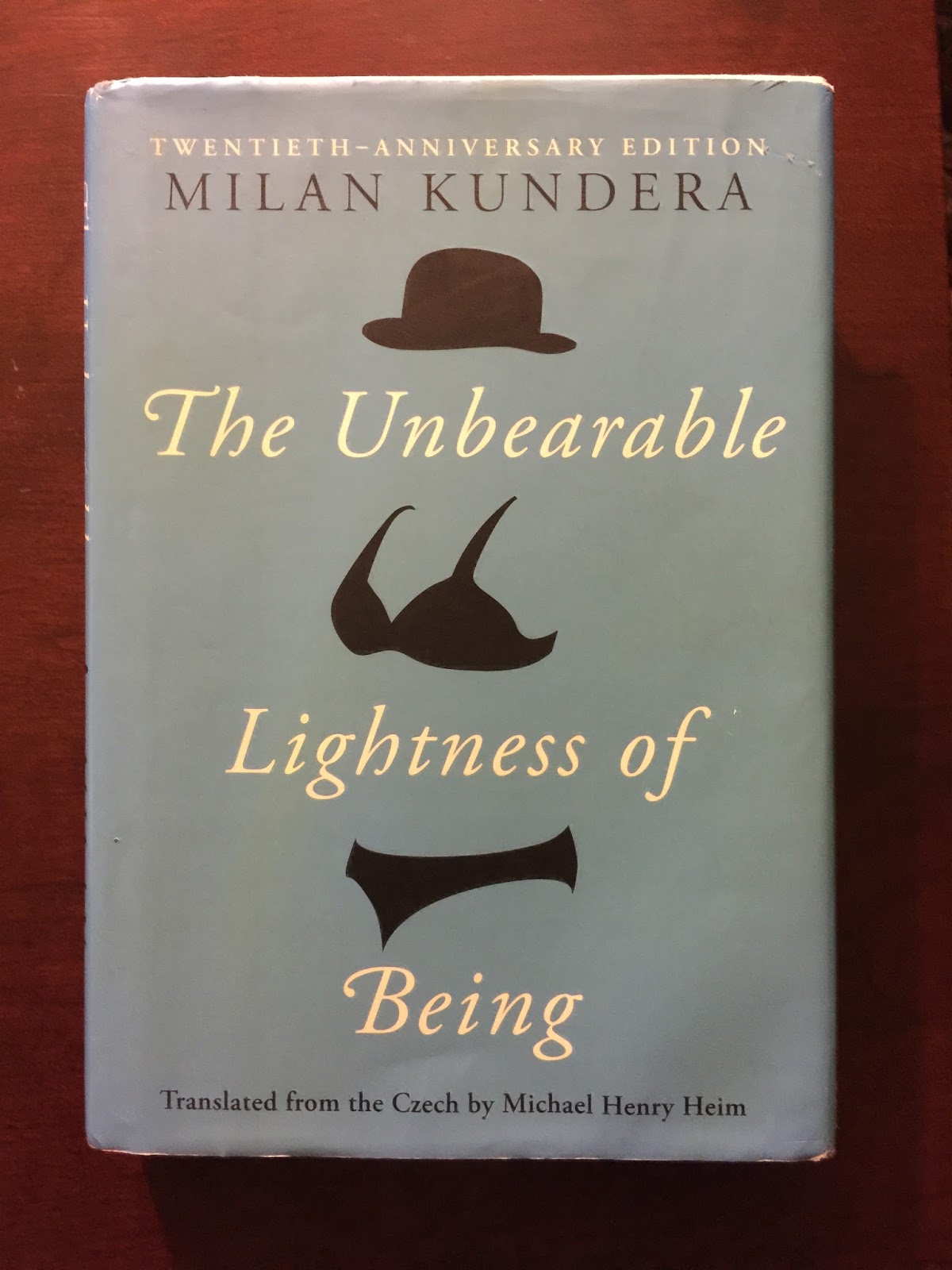
THE UNBEARABLE LIGHTNESS OF BEING: BY MILAN KUNDERA 1984
.
It rarely happens that as soon as you finish a book, you start reading it again from the beginning, This is what happened to me with this book.
Watching me go through some 'metamorphosis' at this time of my life, my son gave this present to me.
It is a genre not known to me from before, the philosophical fiction.
Milan Kundera is a perennial Nobel candidate. He is a Czech national, lived through the vicissitudes of Russian invasion, left the country and is now a French citizen.
There is a story but then there is the philosophical axis. It is there on every page. You can read any page out of the book. and it will stand alone like a day book. You will get something out of it, even if you have no idea of the story line running along.
It basically is a counter argument to the Nietzsche's concept of 'eternal recurrence of the same'.
Simply put, Nietzsche put forward a possibility that there can be a limited number of occurrences and in the infinite time, they have to keep on recurring.
Milan argues against that, claiming that the burden of eternal recurrence is very heavy. It will keep the individuals down as they have to carry this burden. As we often say we have the burden (or baggage) of culture, history, religion, family values etc which keep on burdening us as time goes.
Once one is relieved of this burden, life will be very light and easy to handle.
Then he tells a story.
During the whole story, he builds the philosophical argument and the reader slowly falls into the trap of his argument. That is the beauty of the story.
Prague Spring is perhaps the first of the 'Springs'. The Arab Spring in last few years gets its name from Prague Spring. "Spring" because there was a period of political liberalization with the hope of better times to come. It did not happen then and it did not happen with the later 'Springs', including Beijing Spring a decade later and Arab Spring in early 2010's.
Story itself is based in his home country, former Czechoslovakia, in late 60's and early 70's. Now a former Soviet bloc country, it was the time when the communists were in charge and Soviets invaded as communists started to think of spring and openness. Result was a total crackdown and a despotic dictatorship.
It bore a lot of similarities with the time I grew up in Pakistan. Similar kind of totalitarian government, although not communist, but still dictatorial. You see the same application of deep state tactics. We see how a successful professional, a surgeon, gradually goes down the social and economical ladder and in the process, realizes the burden being shed and feels the happiest and lightest towards the end.
The protagonist's character reminded me of many people around me. I have seen some good friends who started with a good worldly life and then life dealt them a bad set of cards; especially a friend who has lost the privilege to work as a physician and is now a state guest.
Czechoslovakia was a modern country, socially and economically more advanced than USSR and when the soviets moved in, they faced an advanced and liberated country, including its women. The interaction was interesting and eventually let down the cultural and social level of the nation. It was a more oppressive ideology taking over and dragging the whole culture down with it. Again something which we have seen happen in our backyard in our own lifetime.
A few deep observations I could not resist not to share.
Citing the examples of characters in the novel, he mentions four type of people who long for different set of eyes, which could be a sit in for need to be noticed.
One, who long for unknown set of eyes. These are the fame seekers, like artists etc. They feel happy that many people know them, even if they are not close to them in real life. They bask in that limelight, even if it they are under real or imagined scrutiny by the secret service and deep state. They thrive in that.
Second are those who long for many familiar set of eyes. These are people who want to be popular in their own circles. They are the one who throw parties and be sure they are talked about all the times. They are heavily dependent on others for their happiness and have to actively maneuver that popularity.
Third are those who want to be in the eyes of those few whom they love. They are the lovers, who want to please only the one they love and do not care much about the rest of the world.
Lastly the fourth type are those who look for the eyes of those who are not present there. They are in search of ideal and look for approval of their ideal even when no one is looking. They are the dreamers and idealists.
Another astute observation is about the two type of men who have many relationship with women.
One are those who look for one women in every women. You see that most of their women have many things in common and their friends some times call all of them by the same name. They soon get fed up by one women and move on. They earn the reputation of being unfaithful by their women.
You can see the examples of these men in people around you. At least one popular national leader of Pakistan has that trait. All his women look similar in some ways.
The other type of men are who look at each women in a different way and want to explore that uniqueness about that person. They have more passionate relationship and even when they move one, there is not that sense of abandonment by their women.
Another great quote and I am paraphrasing. If the powerful are too weak to kill the weak, the weak should get strong and leave.
How you are defined after death is largely dependent upon your heirs, form the inscription on the tomb stone to how and what you felt in the last days of your life.
Kitsch is excessive sentimentality and thus is considered in poor taste. In its metaphysical meaning is the absolute denial of everything which is unacceptable. We do that in all belief systems. For example, man is created in the image of God but God cannot have alimentary issues ( Intake and output); every thing is best in a Communist society, ( or for that matter, in a religiously devout society) and so on and so forth. Some people dwell in it and others try to run as far away from it as possible.
And so many more astute observations like that.
It was pure joy to read the book and recommend to anyone who has not read it and likes the philosophical axis of everyday life experiences
