Saturday, January 31, 2015

Guy Delisle 'Pyongyang'

Finished reading a graphic book by 


 Guy Delisle 'Pyongyang'.

A wry and witty comedy about the life in North Korea. Gives a glimpse of life in a totalitarian regime. It tells the story of the author who goes to Korea as an animation artist. It seems that North Koreans are interested in the foreign artists as a source of foreign exchange.

A few observations.
  • Every visitor was given a bouquet  of flowers apparently as a gift and then the guide advises the guest to go to the highest place in the city for a view. There you see the hugh statute of Kim Il Sung and everybody is expect to place the flowers there. So you are duped into paying respects to the great leader
  • Every visitor has to have a guide and cannot go anywhere literally without them
  • People are constantly reminded of the Japanese and Korean war and the atrocities of Imperial Japan and USA
  • Father and son Kims are present everywhere. On the walls, on the shirt pins, on the mountains, on the buildings and if you do not wear it, you are automatically a suspect.
  • He did not see any handicap person during his two months of stay
  • Entire highways are build to take foreigners to museums honoring the Kims.
  • Kim Junior, ( now since deceased) had composed many songs and directed many movies.
  • The neck tumor of Father Kim has been photo-shopped from him images
  • The only Communist dynasty in the world is holding on to its power with a strong cult of the personality.

Tuesday, January 27, 2015

God is Beautiful and Loves Beauty: A Lecture by Ali Asani


Attended the lecture by Ali Asani, a Harvard professor on this topic on Friday, January 23rd, 2015


It was one of the Annemarrie Schimmel Memorial Lecture. I have mentioned another lecture earlier in a post silsila-i-jogiyan
 
While she was the professor at Harvard, Dr Schimmel was a consultant at the Met. As per her student, Ali Asani, she used to travel every Thursday to the Met in NY to work on manuscripts and artifacts.

What he chose as the elaboration of the topic was how the word of God, the Quran is expressed in Islamic art.

He picked an example of various forms of arts. Auditory/Sonic, Calligraphy, Architecture, objects of daily use, like water filters and outer garments. 

AUDITORY:
First was the example of art in the auditory sense. This was the way the Quran was experienced by the Prophet and the early Muslims. Written form was there to document it and preserve it. The actual Quran was the oral version and rendition of it. That is how it was experienced by the faithful and is still the mainstay of Quranic experience.

He played three different recitations of the Fatiha and elaborated how each rendition had a different effect musically on the listener. He gave the example of Caliph Omar and how he entered Islam after listening to Quran while on a mission to find how and why his sister converted to Islam

CALLIGRAPHY:
Second is the calligraphy and the written form of Book. He showed a few examples of the artistic calligraphy of Quran.

quran
click here


ARCHITECTURE:
Then in architecture. Here is showed how calligraphy is a part of the interior decoation of the Mosques dome and its mosiac's work


click here

ARTICLES OF DAILY USE: UTENSILS
Then he showed an example of a water filter which has quranic inscription in it and the words of Quran itself become the filter. As if the water is purified physically while going through the small pores of the filter, it is at the same time is being spiritually purified by the words of God.

Could not find a picture of the filter

GARMENTS:
Garments. There was an example of Quran as a talisman. Weaved and written on a tunic, the whole of Quran. It was to be worn by the Sultan under the Armour as a talisman to protect the king from enemy. It was interesting to see something like this, as I thought printing of Quranic verses on clothes is discouraged in Islam. I was wrong.

http://www.materialcultures.com/wp-content/uploads/2013/10/Lot-58-Talismanic-shirt.jpg

Talismanic-shirt.jpg

Here is another example

MUSIC (AGAIN)
In the end, the music. He showed a video performance of Rumi by Farida Mahwash of Afghanistan singing the Sound of the Soul by Rumi (mathnavi maanavi), telling the story of the Reed, as it has been separated from the tree. Similar concept is expressed in some of the Pumjabi sufi lyrics.
Sound of Soul


Monday, January 12, 2015

Touring Multan, with Shakir Hussian Shakir

Revisiting the Past

In a City of Living Dead

گدا و گورستان


https://www.flickr.com/photos/nasirgondal/16232140776/sizes/c/in/photostream/
During the recent trip to Multan for APPNA Winter Meeting, I took a city tour arranged for APPNA members and their families. I have lived in Multan during my first years of medical school at age 18-20. It is a city with lot of influence on me. 

And for the last several years, almost for two decades, for various reasons, whenever I visit Pakistan I go to Multan. I spend a day or two visiting my class mate Shakeel Ahmed of Biochemistry in Nishtar. We remisnice on our old days, usually have a sitting with old comrade Salamatullah, now retired from Forensic Deptt.  Zafri Shah, from Khanewal is always gracious, visits Multan and then usually accompanies me to a trip further south to Bahawalpur and Yazman. 

So I go to Multan every year, but hardly visit the city. Just spend time with friends and move on. I never feel myself as Multani, but do feel a certain sense of allegiance. Taking the trip as a tourist with a guide is always interesting and now I had an opportunity to visit the streets of the past, so I jumped on the tour bus.

APPNA Winter Meeting was arranged by Haroon Durrani, whose family is a centuries old resident of Multan. His father in law, Late Umer Kamal Khan, has written a book on Multan's history and has been pivotal in restoring the Library of Multan. 

The local host committe headed by Ijaz Masood and team had arranged a great program, which was toned down due to the Peshawar massacre.

For the tour they chose well the guide. Shakir Hussain
a lifetime Multan resident, a literary person with a deep sense of Multani Pride. His guidance made it all worthwhile.


https://www.flickr.com/photos/nasirgondal/16071916029/sizes/z/in/photostream/


Almost all of what I write here is what I learnt from him. 
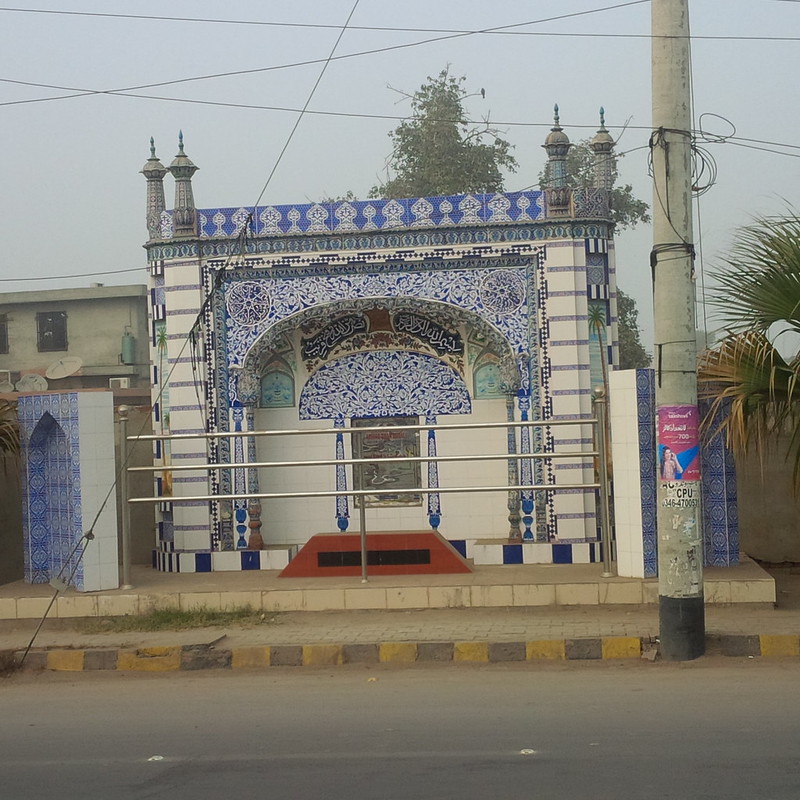
We started off from the Hotel, which is on Abdali Road. It is called Abdali Road as it is believed that Ahmad Shah Abdali was born in Multan. He was soon returned to Afghanistan and never lived here as an adult. There is a monument to commemorate that.
https://www.flickr.com/photos/nasirgondal/16070684790/sizes/c/in/photostream/


Multan, Shakir said, is continuously inhabited for 3000 years by now, making it one of the oldest cities.

The road took us straight to Bohar Gate. The old city of Multan has six gates, Bohar, Pak, Haram, Dehli, Daulat and Lahori Gates. 

I remember Bohar Gate well. During my time as a student, somehow I got fascinated by the Beeri smoking and switched from Gold Leaf to Beeri Smoking. It is tobacco wrapped in the Beeri leaf, which is dried kachnar perhaps. The place to go for beeri was Bohar Gate.

Multan is a city of saints, The oldest saint in Multan was Moj Darya. I always thought that a place called Pul Moj Darya was perhaps a bridge on a vigorous river, since dried. I did not know that it was the name of a saint.

The second saint to come to Multan was Shah Gardez, from Gerdez of Afghanistan. His tomb is inside the Bohar Gate. It is believed that in those days, the wall of the city was flanked by River (perhaps Chenab) and every year it used to cause havoc to the city during flood season. The first miracle of Shah Gardez was to put his shoes in the rive and order it should never flood again. And so did happen.

We toured the city along the wall, on the outside. Next came Pak Gate. Here is the tomb of Musa Pak, a descendant of Abdul Qadir Gilani and forefather of the ex Prime Minister Yousuf Raza Gilani.  Then came Haram Gate. We always thought it is called Haram Gate as it is the red light area and many of my college friends entered manhood through these gates. Shakir Hussain told us that it is called Haram Gate as it was the exclusive entrance for the aristocratic ladies of the times. 

Similarly Daoulat Gate is called so for the reason of having the tomb of a saint Daulat Shah. 

My first encounter with Multan was at Daulat Gate. My uncle, Taya Afzal, used to live there. He was a professor of Physics in Emerson College. As a kid I was there when another uncle of mine, Mammo Munawar, got married in Fort Colony Multan, we had gathered at Taya Afzal's house to prepare for the Baraat Procession. And when I went to Nisthar, he was still there, although retired for a long time. I spend my first few days in his house before shifting to the campus.

Back to the tour. We had the traditional breakfast of the city, Aalo Bhi Chole Pura,  a mixture of Potatoes and a vegetable called Bhi with chick peas and a hard purra. Made at night by women at homes and then brought to the streets by men and sold hot or cold. 

Part of the old wall is being rebuild from a grant by an Italian organization. It will restore the old look to the part of the walled city. Next we saw the Khooni Burj, the  Bloody Bastion between Dehli Gate and Pak Gate http://en.wikipedia.org/wiki/Bloody_Bastion#mediaviewer/File:Khooni_Burj_or_Bloody_Bastion_Multan.jpg


Thought of as the place where Alexander was defeated and the Tower was all bloodied by the defending warriors. But perhaps the name is due to the war between Sikhs and British.

Right on top of the Tower is the Students Tazia, Shagird ka Tazia. 


https://www.flickr.com/photos/nasirgondal/16258049065/sizes/z/in/photostream/

Multan, famous for its Muharram Shia processions, has two famous tazias Ustad and  Shagird, i.e. Teacher and the Student. Perhaps at some time the Student thought that he can make a better Tazia than his Teacher he made one and now this is the place from where its procession starts.  Interestingly, Shakir told us, that most of the licences to hold Tazia ( which total more than 100) are held by Sunnis and not by Shias. Shagird's Tazia is similarly owned by a Sunni. That is a unique example of Shia Sunni understanding in Multan. Skeptics say it is the way the sunnis exploit the situation financially by subletting the licenses to Shias. 

The Tazia of Shah Gardez, where I had attended some shia majalisis as a student, is not taken out and is buried at the end of the month. Perhaps there was a time of prosecution and it was observed in secret. Now the tradition continues. 

Shams Sabswari, sometimes wrongly assumed to be Shams Tabriz is another well known saint of Multan. Now there is a big park around the tomb. In our college days, there was a big mela on the urs of Shah Shams. That was the first time I had seen a live performance of dance girls. Still remember the famous song Mathe pay sonay ki bindya lagaai  https://www.youtube.com/watch?v=pHzBCqA5H8s

Then the trip to the fort. It is in the center of the walled city and hosts the two main monuments Bahudding Zakaria and Shah Rukn Alam. There was a third building, that of the Hindu Temple Prahladpur. It is here that the Hindu custom of Holi, started here http://en.wikipedia.org/wiki/Prahladpuri_Temple,_Multan

In the aftermath of the destruction of Babri Masjid in 1992, almost all of the Hindu places of worship were destroyed, including this iconic temple

Said to hear that although there is Hindu and Sikh population in Multan, they do not have a shamshan ghaat to cremate their dead. Now they bury their dead, the same way as Muslims. The intolerance has gone up with time.

Now they have built a Damdama view point at the Qila, and one can get a great view of the city. It was quite foggy on the day, we were there and could not see much, except the birds and the misty sky.


https://www.flickr.com/photos/nasirgondal/16070521818/sizes/m/in/photostream/
The old shop Nigar Khana is still there and you can get the cheapest deals of artifacts there. Sajid and Rubina bought almost all of what was left by others, for their new house in Orlando.

The Tomb of Shah Rukn e Alam, is the top most location in Multan and every visitor goes there. I had the question of the six pointed stars in the inner wooden door which I noticed the first time I visited the Mazaar after being aware of David's star, and asked the question to Shakir Hussian. He thought the resemblance is coincidental and must have been the innovation of the artisans without knowing the Jewish connection.


In this city of saints, the more recent entry is of Molana Hamid Ali Khan, the religious leaders of Rohtak Hasar migrants to Multan.  

In the end, on the way to the renovated Library, which Umer Kamal Khan help renovate, but did not live to see it inaugurated, we did go past the Graveyard where Attaullah Shah Bukhari, the famous orator and Deobandi leader is buried, perhaps in an unmarked grave.


Tuesday, November 11, 2014

ARE YOU AN ETHICAL PERSON?

A Lecture by Tom Cooper

@

Emerson College, Boston

This October, I attended my first lecture on Ethics. It was Haleema's Family Weekend (Parents Day) and there were mock lectures for parents to attend. I wanted to attend lectures in her course but she encouraged me to attend those I find interesting. This was an interesting topic so I decided to attend.

We, growing up in Pakistan, were never exposed to the subject of ethics in our schooling. Religion was and is considered the ultimate source of ethics and morality. As long as we have learnt the Book and the Tradition, we perhaps do not need anything else. We were encouraged to think that the sole path to ethics and morality is routed though religion. A person without Divine connection is devoid of any morality or ethical element. With time some of us learn that mindset is condescending. Ethics predate organized religion.

 Here in the West, the study of ethics and the development of ethics in the human history is an integral part of learning.


The lecturer, it turned out, is a renowned professor in his field. Tom Cooper. His books include FAST MEDIA / MEDIA FAST, and available at Amazon. It in on my list of next book to read.


The topic was '"Are you an Ethical Person"


He started by giving a few definitions of ethics and how one type of ethics, may conflict with another. for example the ethics learnt from the home or religion/faith system may have a conflict with the ethics of the profession or the workplace; and the art is how to reconcile the conflict.


He showed a clip from the movie MASTER AND COMMANDER based on two Napoleonic War-era adventure novels in author Patrick O'Brian's Aubrey/Maturin series. In the movie the ship’s captain was played by Russell Crowe. It is rated as one of the best Naval movies.

He takes the ship on a rough and dangerous course. This is in search of prize. In this risky adventure, some of the sailors have to be on the rudder and try to steer it in a certain direction in a turbulent and stormy sea. As a result of the rough sea, one of the sailors, who is quite liked by everyone, falls off with a large piece of rudder along with him. The rope attached to the ship is now pulling the whole ship in one direction. There is a real danger that the whole ship may sink if that continues to happen. As all the hopes of rescuing the man are lost, the captain makes a decision to have the rope cut off, thus drowning the sailor in the turbulent sea. The ship is saved and all the worried crew and the slaves on the ship are happy and relieved.


After showing this clip, the professor posed the questions. 

Was it an ethical decision? Saving one man vs the possibility of drowning the whole ship.
What if the life at risk was not one vs 100 but 10 vs 100 or 50 /50?
Where would one draw the line?
Was the Captain right in the first place to take the whole ship in risky waters? etc


Then he enumerated 12 characteristics of ethics and posed which one we identify as the top three important aspects of an ethical question. This he juxtaposed to four persons he has studied as a part of his next book, "Profiles in Moral Courage".  He started by writing about the moral courage and the difficult ethical decisions by Abraham Lincoln. He ended up by comparing him with four persons in the recent history. Nelson Mandela, Gandhi, Mother Teresa and Rachel Carson.


All had to make some tough ethical decisions in their lives. We all face that. The question to ask is:
How you know whether your decision will be an ethical one?
 The history of Ethics development is long. Earliest sources would include Aristotle, who favored a medium path; something between deficiency vs excess. 
Immanuel Kant, simply put, would look at it with a question."What if every one do that, would it be good?" He emphasized to treat everyone as an end and not as a means.

John Stewart can be included in this list. Greater good; utilitarian approach is the way to reach an ethical conclusion in every case. 

And then we have our religious sources, Biblical Golden Rule, Buddhist, Tao etc
 So, in his own words, how you decided if one is making an ethical decision or not.

When you are about to make a decision, what impact it would have in the following areas. Some are overlapping, but still separate ends.

  1. Peacefulness. Will the outcome bring peace vs otherwise
  2. Equality: Will the outcome promote equality
  3. Justice: Will justice be served by the decision
  4. Compassion: Is the decision compassionate to people affected by it
  5. Forgiveness: Does it promote forgiveness
  6. Unconditional Love: self explanatory
  7. Non Discrimination:
  8. Unity: Will the outcome bring people together in a quest of unification
  9. Fairness: Is the decision fair to parties involved
  10. Inclusiveness
  11. Survival for All: Does the decision assure survival of all including non humans
  12. Humanitarianism
In his analysis the four personalities he studied had different priorities.

Gandhi:
  1. Perfect Outcome: The Brits were leaving and although Partition was not what he wished, he had to agree to something which has the least risk of worst outcome
  2. Equality
  3. Justice
Mandela:
  1. Non Discrimination: was the top most priority for him
  2. Unity: of the country was the second most
  3. Fairness: would come next
(Mandela in a dialogue with Gandhi's grandson Arun, was not as much committed to non violence as Gandhi would have been)

Mother Teresa:
  1. Compassion: consistent with the religious tradition
  2. Forgiveness
  3. Unconditional Love
Rachel Carson: The pioneer environmentalist
  1. Inclusiveness: environment issues
  2. Survival of all: including non humans, and the future generations
  3. Humanitarianism 
Chose your one top three and see where you stand.


At the end of the lecture I walked to him and had a little chat. I asked who is an example of ethical standard in today's time one should look up to. 

He responded: Malala

Thursday, August 28, 2014

Ah! Cader Cheique

Abdul Qadir Sheikh As I Knew Him

https://www.facebook.com/cadercheique?fref=ts


Abdul Qadir Sheikh is a big name. The saint of Baghdad. Invoking the Divine power of qadr and fortitude, it is not easy to fill the shoes of someone with that name. The Abdul Qadir I knew, was no less than the name his parents chose for him.

I cannot say surely how long ago, but it was around 15 years back when I must have first met him. This was the time most of physicians of my age were settling in. We had a relative level of comfort in our jobs. We all felt the need and had the time to reach out and explore the wider community around us. The NY Chapter of APPNA was already established and had undergone a kind of 'awami' turnover. Skeptics have started to join and eager to explore what was in it for them, socially and politically. A regular process of annually elected slate of officers was in place. Many of us who had done our residencies in NY area knew each other through friends and collegues from different geographic backgrounds and alumni associations. 


It must have been in one of the NY APPNA meetings that I first met him. He was the most shy, humble and private person, until you knew him a bit; and he started to talk. He was one of those where the first impression is the farthest from the final impression. And strangely, you would hardly find anybody who would think of him differently. Everybody liked him, enjoyed his company and nobody harbored any ill will towards him.


Those who stay behind in NY are either tied to a rope of family and personal interest, (with a short leash), or are able to appreciate the richness of life over the life of riches. He perhaps had both the reasons. He had a large family in the NY area and wanted to bring up his family in that network. He also had less than average interest in the worldly markers of success. He was most content with what he had and you could not find a person more satisfied than him.


He had a job in Elmhurst, a city hospital with all the benefits and limitations of a city job, including a predictable time table, fringe benefits and the luxury to do what ever you wanted to do after 5 pm; an option not available to most of us.


I say that because it helped him experience the life, as he had a shorter life sentence than most of us, to the fullest. Perhaps a lot fuller and richer than most of us would wish in a short period of time. At the same time, he was able to help many in the community who could not afford health care. He was right there, a stone throw away from Jackson Heights, and in the middle of a major city hospital. I have asked him innumerable times to help someone get medical care. He was always gracious to take care of that.


NY Chapter of APPNA used to have four or five councilors. Usually the senior most would later graduate to become an officer, a treasurer, and later move up every year, eventually to the top. He and I perhaps served the longest  tenure as a councilor. He was one year ahead of me, and each year we both passed on the offer to move on. Eventually everybody got tired of us and accepted our request to leave us alone. We shared this unusual problem of not willing to take more responsibility while offering abundant supply of free advice.


It was around six years back when he found out what eventually took his life. He came to know the diagnosis just before a major event he had to arrange, and he kept it to himself. He was the chair of the local host committee for the Annual Retreat of DOGANA, the Dow Medical College Alumni Association. He had colonoscopy before and got the results a day before that. He did not let anybody know about it, or anybody guess about anything wrong, and had the show go on.


In fact this was most typical of him, and one would see time after time. As his disease progressed through each subsequent intervention, he was able to have the show of life go on. He did not let the people around him realize the depth of anguish and pain he was going through. I deal with cancer patients everyday as a part of my livelihood. I have not seen someone like him who kept his dignity to the last, and had been most sensitive to the feelings of others around him even in the twilight hours of his life.


He had kept his head high and lived with grace. The prolonged duration of his illness, gave enough time for his kids to grow up much earlier than their age and deal with the final eventuality. It seems to me that some how Qadir kept the fate at bay. He has proven to be a real Abdul Qadir, invoking the divine power of fortitude over adversity. He stuck around long enough to see his family safely take off without him.

In these days of qehtur rejaal, he was one of a few with whom I could have a deep conversation on any aspect of philosophy, social issues, meaning of life, afterlife and beyond. He was truly enlightened who could understand the depth of the issues and communicate at your level, what ever it is. 

On top of that, he had a unique sense of humor. He could make jokes with a straight face. I do not know of anyone hurt by his words or actions. He tried to bring people closer. Even in the last stages of his life, he had tried relentlessly to bring old friends together who had drifted apart. I hope people remember him for that.

(His last Facebook picture)


I was not one of those close to him. Later in his last few years of disease, he got more private regarding his illness, and I was unaware of many of his hospitalizations and details of his course. 

He became a more private person as he did not want people to offer empty empathy. I respected that and moved back two steps. 

In spite of all that, or perhaps because of it, I feel the loss of a dear friend and I really miss him.

Alwida, my friend Abdul Qadir Sheikh

 
 https://www.facebook.com/photo.php?fbid=10203543643404513&set=a.10202073181123875.1073741828.1017490571&type=1&theater

Courtesy Iqbal Jandga


 https://www.flickr.com/photos/nasirgondal/1213165101
With Pervez Qureshi at NY APPNA Picnic 2006, Sept 10th.


Friday, August 22, 2014

APPNA Gives Back

This is one of the videos shown during the APPNA Banquet on August 16th, 2014 at Gaylord National Harbor

The chair of the Local Host Committee had asked me to come up with a slide show of APPNA's work. He thought that many of the banquet attendees may not be aware of the social and charity work of APPNA. It may help people be aware of the projects of APPNA.

When I started to collect pictures, I realized how spread out the pictorial history of APPNA is. There is really no good archival collection in the office. Each year APPNA publishes three to four newsletters/journals with many pictures in them. The record of the pictures are not available in the office. I tried many directly and others through the APPNA blast mail. Many complied and their names are acknowledged at the end of the video. Much more could have been shown, but I did not have the pictures to show that

The basic emphasis is on the giving back by APPNA and its members to Pakistan and the adopted country in the last ten years or so. It starts with some of the cover shots of APPNA journals. That gives the artistic side of APPNA publications and its editorial team. It is followed by the advocacy work, educational projects, services to the young physicians and the disaster relief, both here in the USA and back home. Eye camps, Bone Marrow Registration Drive, Hepatitis Initiative, Cytogenetics lab, Public Health Institute and APPNA Foundation are included.

Much more could have been included but I did not have the pictures. I regret that.
I thank the local host committee to provide me with this opportunity to compile this. I commend Asif Rehman for allowing complete editorial discretion.

The video was compiled and edited on Final Cut Pro. I had no idea that a 'just a simple slide show' could be so complicated. All the technical and editing was done by my daughter Haleema. It could not have been done by me without her participation. I am indebted to her.

https://www.youtube.com/watch?v=nO-pSiJMWfA

Nasir Gondal