Showing posts with label APPNA. Show all posts

Tuesday, July 11, 2017

This Land Is Your Land : In Urdu


This famous song by Woody Guthrie is considered  a Marxist response to Irving Berlin's " God Bless America".
http://www.npr.org/2000/07/03/1076186/this-land-is-your-land.

Popular like, 'Sohni Dharti Allah Rakhey" it is like people's national anthem. 

It is the story of a disenfranchised man, roaming America coast to coast, happier on the road than at home, and with the assertive feeling that the land belongs to him too. Some verses are more radical than others. Although US-centric, it has a universal appeal.

This was one of the songs celebrated by Obama's inauguration celebrations.

In the APPNA convention this year, 2017, it was sang on the stage by Fajjr. https://www.youtube.com/watch?v=drjzqB_LGX8

Here is the full version, of one of the versions, with my translation

====================================================

This Land is Your Land
by
Woody Gurthie

https://www.youtube.com/watch?v=wxiMrvDbq3s

This land is your land, this land is my land
From California, to the New York Island
From the redwood forest, to the Gulf Stream waters
This land was made for you and me

یہ ہے تیری زمیں یہ ہے میری زمیں
اس کی ایک اک گلی ہے تری اور مری
کیلی فورنیا سے لے کے نیو یارک تک
سرخ پیڑوں کے جنگل سے ساحل تلک

یہ ہے تیری زمیں یہ ہے میری زمیں
اس کی ایک اک گلی ہے تری اور مری

As I was walking a ribbon of highway
I saw above me an endless skyway
I saw below me a golden valley
This land was made for you and me

تہہ کیے ہیں سفر میں نے شاہراہ پر
ہیں خیاباں فضامیں تا حدِ نظر
اور نیچے ہے بکھری سنہری زمیں
رشک کرتی ہے جس پر بہشتِ بریں

یہ ہے تیری زمیں یہ ہے میری زمیں
اس کی ایک اک گلی ہے تری اور مری


I've roamed and rambled and I've followed my footsteps
To the sparkling sands of her diamond deserts
And all around me a voice was sounding
This land was made for you and me

شوقِ آوارگی میں میں ہر جاگیا
میرے قدموں تلے تھا ہر ک راستہ
ریت چمکے جہاں پہ وہ صحرا ملا
ہر جگہ سے مجھے یہ ہی آئی صدا

یہ ہے تیری زمیں یہ ہے میری زمیں
اس کی ایک اک گلی ہے تری اور مری

The sun comes shining as I was strolling
The wheat fields waving and the dust clouds rolling
The fog was lifting a voice come chanting
This land was made for you and me

دھوپ دھرتی پہ یوں مسکراتی رہے
فصلِ گندم صدا لہلہاتی رہے
رنگ چڑھتا رہے دھند مٹتی رہے
ہر طرف سے یہ آواز آتی رہے

یہ ہے تیری زمیں یہ ہے میری زمیں
اس کی ایک اک گلی ہے تری اور مری

As I was walkin' I saw a sign there
And that sign said- no tresspassin'
But on the other side... it didn't say nothin'
 Now that side was made for you and me!

راستے میں مجھے ایک کتبہ ملا
ــآگے جانا نہیں اس پہ یہ درج تھا
اس کی پچھلی طرف تھا نہیں کچھ لکھا
اس کا مطلب تو میں نے یہی ہے لیا

یہ ہے تیری زمیں یہ ہے میری زمیں
اس کی ایک اک گلی ہے تری اور مری


In the squares of the city-In the shadow of the steeple
Near the relief office-I  see my people
And some are grumblin' and some are wonderin'
If this land's still made for you and me

چوک بازار کا سایہ مینار کا
ایک مجمع ہے افرادِ لاچار کا
ہیں وہ حیرت ذدہ ہے یہ کیا ماجرہ
جو تھی ان کی زمیں کھو گئی ہے کہیں

یہ ہے تیری زمیں یہ ہے میری زمیں
اس کی ایک اک گلی ہے تری اور مری

Nobody living can ever stop me
As I go walking that freedom highway;
Nobody living can ever make me turn back
This land was made for you and me


کوئی ایسا نہیں جو مجھے ٹوک دے 
میری آزادیوں کی ڈگر روک دے
نہ ہے ایسا جما جو یہ ہمت کرے
مجھ کو جانے نہ دے کہہ کہ ہٹ جا پرے

یہ ہے تیری زمیں یہ ہے میری زمیں
اس کی ایک اک گلی ہے تری اور مری

ناصر گوندل


Monday, January 12, 2015

Touring Multan, with Shakir Hussian Shakir

Revisiting the Past

In a City of Living Dead

گدا و گورستان


https://www.flickr.com/photos/nasirgondal/16232140776/sizes/c/in/photostream/
During the recent trip to Multan for APPNA Winter Meeting, I took a city tour arranged for APPNA members and their families. I have lived in Multan during my first years of medical school at age 18-20. It is a city with lot of influence on me. 

And for the last several years, almost for two decades, for various reasons, whenever I visit Pakistan I go to Multan. I spend a day or two visiting my class mate Shakeel Ahmed of Biochemistry in Nishtar. We remisnice on our old days, usually have a sitting with old comrade Salamatullah, now retired from Forensic Deptt.  Zafri Shah, from Khanewal is always gracious, visits Multan and then usually accompanies me to a trip further south to Bahawalpur and Yazman. 

So I go to Multan every year, but hardly visit the city. Just spend time with friends and move on. I never feel myself as Multani, but do feel a certain sense of allegiance. Taking the trip as a tourist with a guide is always interesting and now I had an opportunity to visit the streets of the past, so I jumped on the tour bus.

APPNA Winter Meeting was arranged by Haroon Durrani, whose family is a centuries old resident of Multan. His father in law, Late Umer Kamal Khan, has written a book on Multan's history and has been pivotal in restoring the Library of Multan. 

The local host committe headed by Ijaz Masood and team had arranged a great program, which was toned down due to the Peshawar massacre.

For the tour they chose well the guide. Shakir Hussain
a lifetime Multan resident, a literary person with a deep sense of Multani Pride. His guidance made it all worthwhile.


https://www.flickr.com/photos/nasirgondal/16071916029/sizes/z/in/photostream/


Almost all of what I write here is what I learnt from him. 

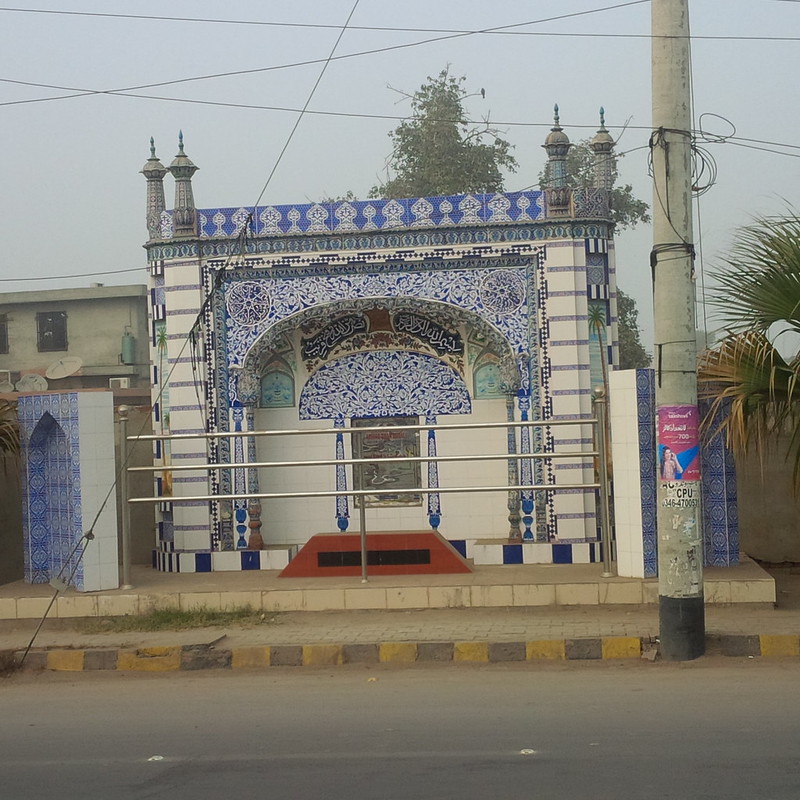
We started off from the Hotel, which is on Abdali Road. It is called Abdali Road as it is believed that Ahmad Shah Abdali was born in Multan. He was soon returned to Afghanistan and never lived here as an adult. There is a monument to commemorate that.
https://www.flickr.com/photos/nasirgondal/16070684790/sizes/c/in/photostream/


Multan, Shakir said, is continuously inhabited for 3000 years by now, making it one of the oldest cities.

The road took us straight to Bohar Gate. The old city of Multan has six gates, Bohar, Pak, Haram, Dehli, Daulat and Lahori Gates. 

I remember Bohar Gate well. During my time as a student, somehow I got fascinated by the Beeri smoking and switched from Gold Leaf to Beeri Smoking. It is tobacco wrapped in the Beeri leaf, which is dried kachnar perhaps. The place to go for beeri was Bohar Gate.

Multan is a city of saints, The oldest saint in Multan was Moj Darya. I always thought that a place called Pul Moj Darya was perhaps a bridge on a vigorous river, since dried. I did not know that it was the name of a saint.

The second saint to come to Multan was Shah Gardez, from Gerdez of Afghanistan. His tomb is inside the Bohar Gate. It is believed that in those days, the wall of the city was flanked by River (perhaps Chenab) and every year it used to cause havoc to the city during flood season. The first miracle of Shah Gardez was to put his shoes in the rive and order it should never flood again. And so did happen.

We toured the city along the wall, on the outside. Next came Pak Gate. Here is the tomb of Musa Pak, a descendant of Abdul Qadir Gilani and forefather of the ex Prime Minister Yousuf Raza Gilani.  Then came Haram Gate. We always thought it is called Haram Gate as it is the red light area and many of my college friends entered manhood through these gates. Shakir Hussain told us that it is called Haram Gate as it was the exclusive entrance for the aristocratic ladies of the times. 

Similarly Daoulat Gate is called so for the reason of having the tomb of a saint Daulat Shah. 

My first encounter with Multan was at Daulat Gate. My uncle, Taya Afzal, used to live there. He was a professor of Physics in Emerson College. As a kid I was there when another uncle of mine, Mammo Munawar, got married in Fort Colony Multan, we had gathered at Taya Afzal's house to prepare for the Baraat Procession. And when I went to Nisthar, he was still there, although retired for a long time. I spend my first few days in his house before shifting to the campus.

Back to the tour. We had the traditional breakfast of the city, Aalo Bhi Chole Pura,  a mixture of Potatoes and a vegetable called Bhi with chick peas and a hard purra. Made at night by women at homes and then brought to the streets by men and sold hot or cold. 

Part of the old wall is being rebuild from a grant by an Italian organization. It will restore the old look to the part of the walled city. Next we saw the Khooni Burj, the  Bloody Bastion between Dehli Gate and Pak Gate http://en.wikipedia.org/wiki/Bloody_Bastion#mediaviewer/File:Khooni_Burj_or_Bloody_Bastion_Multan.jpg


Thought of as the place where Alexander was defeated and the Tower was all bloodied by the defending warriors. But perhaps the name is due to the war between Sikhs and British.

Right on top of the Tower is the Students Tazia, Shagird ka Tazia. 


https://www.flickr.com/photos/nasirgondal/16258049065/sizes/z/in/photostream/

Multan, famous for its Muharram Shia processions, has two famous tazias Ustad and  Shagird, i.e. Teacher and the Student. Perhaps at some time the Student thought that he can make a better Tazia than his Teacher he made one and now this is the place from where its procession starts.  Interestingly, Shakir told us, that most of the licences to hold Tazia ( which total more than 100) are held by Sunnis and not by Shias. Shagird's Tazia is similarly owned by a Sunni. That is a unique example of Shia Sunni understanding in Multan. Skeptics say it is the way the sunnis exploit the situation financially by subletting the licenses to Shias. 

The Tazia of Shah Gardez, where I had attended some shia majalisis as a student, is not taken out and is buried at the end of the month. Perhaps there was a time of prosecution and it was observed in secret. Now the tradition continues. 

Shams Sabswari, sometimes wrongly assumed to be Shams Tabriz is another well known saint of Multan. Now there is a big park around the tomb. In our college days, there was a big mela on the urs of Shah Shams. That was the first time I had seen a live performance of dance girls. Still remember the famous song Mathe pay sonay ki bindya lagaai  https://www.youtube.com/watch?v=pHzBCqA5H8s

Then the trip to the fort. It is in the center of the walled city and hosts the two main monuments Bahudding Zakaria and Shah Rukn Alam. There was a third building, that of the Hindu Temple Prahladpur. It is here that the Hindu custom of Holi, started here http://en.wikipedia.org/wiki/Prahladpuri_Temple,_Multan

In the aftermath of the destruction of Babri Masjid in 1992, almost all of the Hindu places of worship were destroyed, including this iconic temple

Said to hear that although there is Hindu and Sikh population in Multan, they do not have a shamshan ghaat to cremate their dead. Now they bury their dead, the same way as Muslims. The intolerance has gone up with time.

Now they have built a Damdama view point at the Qila, and one can get a great view of the city. It was quite foggy on the day, we were there and could not see much, except the birds and the misty sky.


https://www.flickr.com/photos/nasirgondal/16070521818/sizes/m/in/photostream/
The old shop Nigar Khana is still there and you can get the cheapest deals of artifacts there. Sajid and Rubina bought almost all of what was left by others, for their new house in Orlando.

The Tomb of Shah Rukn e Alam, is the top most location in Multan and every visitor goes there. I had the question of the six pointed stars in the inner wooden door which I noticed the first time I visited the Mazaar after being aware of David's star, and asked the question to Shakir Hussian. He thought the resemblance is coincidental and must have been the innovation of the artisans without knowing the Jewish connection.


In this city of saints, the more recent entry is of Molana Hamid Ali Khan, the religious leaders of Rohtak Hasar migrants to Multan.  

In the end, on the way to the renovated Library, which Umer Kamal Khan help renovate, but did not live to see it inaugurated, we did go past the Graveyard where Attaullah Shah Bukhari, the famous orator and Deobandi leader is buried, perhaps in an unmarked grave.


Friday, August 22, 2014

APPNA Gives Back

This is one of the videos shown during the APPNA Banquet on August 16th, 2014 at Gaylord National Harbor

The chair of the Local Host Committee had asked me to come up with a slide show of APPNA's work. He thought that many of the banquet attendees may not be aware of the social and charity work of APPNA. It may help people be aware of the projects of APPNA.

When I started to collect pictures, I realized how spread out the pictorial history of APPNA is. There is really no good archival collection in the office. Each year APPNA publishes three to four newsletters/journals with many pictures in them. The record of the pictures are not available in the office. I tried many directly and others through the APPNA blast mail. Many complied and their names are acknowledged at the end of the video. Much more could have been shown, but I did not have the pictures to show that

The basic emphasis is on the giving back by APPNA and its members to Pakistan and the adopted country in the last ten years or so. It starts with some of the cover shots of APPNA journals. That gives the artistic side of APPNA publications and its editorial team. It is followed by the advocacy work, educational projects, services to the young physicians and the disaster relief, both here in the USA and back home. Eye camps, Bone Marrow Registration Drive, Hepatitis Initiative, Cytogenetics lab, Public Health Institute and APPNA Foundation are included.

Much more could have been included but I did not have the pictures. I regret that.
I thank the local host committee to provide me with this opportunity to compile this. I commend Asif Rehman for allowing complete editorial discretion.

The video was compiled and edited on Final Cut Pro. I had no idea that a 'just a simple slide show' could be so complicated. All the technical and editing was done by my daughter Haleema. It could not have been done by me without her participation. I am indebted to her.

https://www.youtube.com/watch?v=nO-pSiJMWfA

Nasir Gondal