Thursday, May 28, 2015

My First Mushaira


 Photo credit Vakil Ansari

May 22nd, 2015 was the day of the 4th Annual International Mushaira of Halqa Arbab e Zauq.  Some of the notables from Pakistan and India could not make it. It was presided by Pirzada Qasim. Details can be found in the media, For Urdu Times Click here.


Although I had participated in similar events in college days, this is the first time I read poetry in a proper Mushaira. All my previous 'work' was during college days and since then I had attempted a poem here and there; it was really the encouragement of the Halqa which made me start writing again. 

I am thankful to the Halqa and all those who encouraged including Saeed Naqvi, Vakil Ansari, Naeem Rathor, Abdul Rehman Abd and Baji Nusrat. Special thanks to Shaukat Fehmi whose fan I was from the earlier days I used to attend Halqa sessions in Zameer Jafri and Johar Mir's days of 1990's.
   
This is a ghazal and has difficult subjects in each verse to deal with. I am sure I have not done justice to each subject. For my readers who cannot read Urdu, I have transliterated and translated in the end, without going into much of the details.


Transliteration and translation


tum ko chahiye jesi bood o baash kar day ga
dharkaney jama kar do, ba muaash kar day ga

What ever type of living style you want, you will get
Just surrender your feelings, and (big brother) will take care of you

sung kay muqadar ka teshagar musanif hay
nehr khod laye ga, but(h) tarash kar day ga

The destiny of the rock is authored by the stone cutter
He can make a water way out of it, or carve a statue
(there are mythical references to it, Sheren Farhad story)

soch ki qadamat ne so tahen lagai hain
aaghi ka ik lamha ramz faash kar day ga

Fossilized thoughts have put hundreds of layers
One moment of enlightenment is enough to reveal the hidden truth

dostoon kay qissay ko chairtay nahi socha
munhalik yey saniha e dilkhirash kar day ga

You did not realize when you started to talk about old friends
This heartwrenching episode will be fatal

ma'badon kay bargad say fikr to paray rakhna
ye milap paiwande irtiaash kar day ga

Keep (independent) thoughts away from the Banyans of Worship Houses
This joint will end up in trembling of the (profoundly calm) tree

deed kay talabgaro hosla muqadam hay
jils(e) yusofana hay qaash qaash kar day ga

Have to have a strong heart before you ask for audiance
Seeing Joseph will end up (you) cutting yourself in peices
(Reference to the Quranic story of ladies of Egypt cutting their fingers when seeing the captive Joseph)

sahiron ka Halqa hay soch kar qadam rakhna
kis qumaash kay tum ho kis qumaash kar day ga

Think (twice) before you step in the circle (halqa) of these magicians
It will make you a different person
(reference to Halqa Arbab e Zauq)

raastay ki shorish say zaat ko bacha laya
tahelka do ander hay paash paash kar day ga

I kept myself safe from the vicissitudes of the journey
The turmoil inside me is what will decimate me

terey kaflay ka wo aakhri payada hay
jo gohar gira tuj say wo talaash kar day ga

He is the last man walking in your caravan
Whatever is dropped (lost) by you will be found by him
(there is a historic reference for those who know)

Wednesday, May 27, 2015

Jahangir Shoots Malik Anbar

The African Slave Who Stood Up To The Mighty Mughal

 ملک عنبر


"Jahangir Shoots Malik Ambar," Folio from the Minto Album

Artist: Painting by Abu'l Hasan (Indian, born ca. 1588/89, active 1600–1628)
Object Name: Album leaf, illustrated
Date: ca. 1616
Geography: India
Culture: Islamic
Medium: Ink, opaque watercolor, and gold on paper
Dimensions: H. 10 3/16 (25.8 cm) W. 6 1/2 in. (16.5 cm)
Classification: Codices
Credit Line: Trustees of the Chester Beatty Library


On the exhibition, please refer to the separate blog, click here.

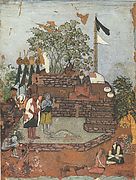
Of the various artifacts on display in the exhibition in Met, the  Sultans of Deccan India 1500-1700: Opulence and Fantasy what fascinated me the most was this painting.It shows the Emperor Jahangir aiming yet another arrow at the severed head of his nemesis Malik Anbar.

Many things gather my attention in this painting.
This is not an Deccani painting. It is a Mughal painting from1616 by Abul Hasan
.
Malik Anbar had recaptured Ahmadnagar (now in the state of Maharashtra) occupied by Akbar.  Now Jahangir, the next emperor, fought relentlessly to take it back but did not succeed. Malik Anber was his antithesis; to add insult to injury he was an African Slave turned General who stood up to the Royal Mughals.

Malik Anbar is one of the patron saints of the Siddi tribe. This population which is dispersed all over India and Pakistan is supposed to originate from the Africans who were brought or rather bought as slaves over a prolonged period. In Pakistan many in Makran are from this heritage. Manghu Pir is supposed to be from the same ethnicity. They have many African derived rituals. Some say bhangra was introduced in India through their various spiritual traditions. Notable Pakistani scholar N M Danish claims to be a Siddie. Yakut Khan, the slave general in Razia Sultana, was her lover and a Siddie. Aye dille naadan

Malik Anbar was probably sold by his father in Ethiopia due to poverty. His journey as a slave took him to many places including Yemen and Baghdad and finally to South India. He rose eventually to the rank of a General in the Nizam Shahi dynasty of Ahmadnagar.

Slave trade routes from the North were cut of for Deccan as the adversarial Delhi Sultanate was in the way. Later it was replaced by equally adversarial Mughal rule. That provided for the Middle Eastern route of African slave trade. They were preferred as army men as they did not have any kinship issues of their own and would be loyal to the Sultan.

As compared to Africans sold into slavery to the Europeans, the route to the East was more promising. There was good chance that one may rise in the ranks; and as in the case of Malik Anbar, Ikhlas Khan and Yakut, to name a few, one may end up being a General, a Prime Minister or a royal consort. 

Back to the painting. 

Here Jahangir stands in full regalia on the top of the world.  World is depicted as round. This is 1600's and was well known by that time that Earth was round and revolved around sun. Still in this painting, it rests on a cow which rests on a fish which rests on air. This concept of cosmology is old and is also mentioned in the Mantiq uq Teer by Farid uddin Attar.
Full of his royal blood pride, the mention of his pedigree starts with Tamerlane, ie Nooruddin Muhammad Jahangir Padshah e Ghazi, son of Padshah Akbar, son of Padshah Humahyun, son of Padshah Babar, son of Umar Shaik Mirza, son of Miran Shah son of AMir Timur Sahib Qiran.
Anbar is depicted without turban, a sign of insult without the head gear.
Owl is sign of bad omen, and darkness. 
Angels and Cherubs are handing Jahangir the arrows and sword to use against Anbar

It seems strange to me that Jahangir, the Mughal character most associated with tender feelings, the lover Prince Saleem who enamoured Anarkali, and later Noor Jehan (and many in between), the upholder of legendary Twelve Decrees and the Chain of Justice, seems to have quite an appetite for savagery. The fascination with beheading the enemy and displaying the head on a spear and desecrating it as an object of play and wanton is the essence of this painting. These connoisseurs of art were equally brutal in the art of killing.


The description of the painting and the inscriptions:

Jahangir, standing in the light and on top of the world, is aiming another arrow at the severed head of Malik Anbar, which has been pierced by a javelin. The head is without turban, a sign of disrespect.  The severed head is positioned on a spear which is longer than the whole world and the celestial subjects it sits on. An owl, sign of darkness and doom, is sitting on the head of Anbar.  

To the side of the severed head is inscribed:
 خاںی بم شدہ کلیہ شب رنگ غلام 
The night colored head of the dark slave has become the house of the Owl

In between the two, Jahangir and Anbar, is the wishful statement of the fact:
اللہ اکبر 
ہر کاہ کہ در کمان در آئ 
رنگ از رخ دشمن روباہی 

God is Great
whenever it (the arrow) seats it self in the bow 
The color of your enemies' faces fade away

and underneath it

ھو
عنبر بوم کہ از نور گریزاں می بود
تیر دشمن فکنت کرز زی عالم برون 

He (the Lord): 
Anbar, the owl, had fled the light
And has been dispatched from the world by your enemy's arrow.


On the left of the Javelin

 ھو 
باطن گہہ عدوت را چو خکست از خونش سر سنان تو تسر 
He(the Lord): 
The real nature of your enemy is like a swine
whose blood sated your Javelin's head

Jahangir's musket is parked by the spear and on its right is inscribed:

الله اکبر 
تفنگ  شاہ نور الدین جہانگیر 
خطا نبود درا و چوں حکم تقدیر 
کند از سہم جانسوزش بہردم 
زمیں بوسی پلنگ و شیر و نخچیر 

God is Great
The royal musket of Shah Noorudin Jahangir
Does not err just like the Fate's Decree
Because of its arrows' scorching fire, every moment
The leopard, the loin and the wild animals kiss the earth

There is a scale, denoting the legendary sense of Jahangir's justice hanging from a wire between the world and the spear, in perfect balance. It implies that the justice is always done by the Emperor even if the balance seems skewed by external elements.

It gives the example of justice that the lion is suckling milk from goat's teets. A strange example, I thought justice would be manifest if the goat is able to suckle the Lioness. Anyhow, it reads:

اللہ اکبر
عدل شاہ نور الدین جہانگیر
 مکیدہ شیر از پستان بزشیر

God is Great
The justice of Shah Nooruddin Jahangir
The lion is suckling milk from the breasts of goat

Below that

ز یمن مقدم ظل اللہی 
زمیں گشتہ سبک بر گاؤ ماہی 

Due to the good graces of the Shadow of God's ( the Emperor's) feet
The Earth rests lightly on the Cow and the Fish

There is a heavenly bird on the back of Jahangir. Below that and above the Royal Crown is inscribed


ہو 
نو پشت تو تاجور زی یزداں 

He (the Lord)
Nine predecessors of yours were given a crown by the Almighty

And in the roundel below the crown are the names of those nine predecessors:
Starting in the center with his own name and then from one o clock position in the clockwise direction:

نور الدین محمد جہانگیر پادشاہ غازی 
ابن اکبر پادشاہ 
ابن ہمایوں پادشاہ 
ابن بابر پادشاہ 
ابن عمر شیخ مرزا 
ابن سلطان ابو سعید 
ابن سلطان محمد مرزا 
ابن میران شاہ 
ابن امیر تیمور صاحب قراں 

Nooruddin Muhammad Jahangir Padshah e Ghazi, 
Son of Padshah Akbar
  Son of Padshah Humahyun
Son of Padshah Babar
Son of Umar Shaik Mirza
Son of Miran Shah
Son of Amir Timur Sahib Qiran


And finally the signature:
عمل کمترین مریدزاد ہائی 
با اخلاص ابوالحسن 
Work of the Lowest of Low
Son of Disciples
With sincerity
Abul Hasan 


Sunday, May 17, 2015

THE SULTANS OF DECCAN


THE SULTANS OF DECCAN

سلاطین دکن 

1500-1700


Beggar's Bowl (Kashkul) with Pious Inscriptions
Kashkol


Being a Pakistani with no personal family ties to per-Partitioned India, I had a rather naive impression about Deccan for a long time. To me it meant south and as Hyderabad is south of Delhi, so perhaps the rulers referred to the South as Deccan. It was the name of the State with Hyderabad as its capital.


What I remembered from history lessons in school was that somewhere in the times of Delhi Sultanate, perhaps Tughlaq's that South was invaded and it became a part of Muslim rule.


So it was a pleasant surprise when the exhibition Sultans of Deccan India 1500-1700: Opulence and Fantasy opened at Met. It is the end result of ten years of painstaking collection and is on display April 20–July 26, 2015.


The golden age of the Deccan dawned during the reign of the powerful Bahmani Dynasty (1347–1538) who broke away from the Dehli Sultanate.


The Bahmani Sultanate had five provinces in it. After a period of time the four states revolted and declared independent sultanates. The center was declared a separate sultanate the then prime minister. There was an interesting mix of Muslims of different origins and backgrounds. There were the rulers from the North, mostly Afghans and Turks; , then there were Persians ie westerners maghrabain, and Arab traders and African slaves. Over a period of time, the later generation of now ‘native’ Muslims, the Deccani, had a different take on things as the newly arrived foreigners from the North and West. It resulted in many controversies and tensions over these two centuries. 
Eventually, the Sultanates were absorbed by the Mughals. The credit of that goes mostly to nobody other than Aurangzeb, who had spent a life time in Deccan before eventually becoming the King. And later one of his generals, founded the independent state of Hyderabad under the title of Nizam.


The most important of these states was Ahmadnagar, which is now part of the State of Maharashtra. It was first to declare independence and later it annexed a neighboring mountainous state of Berar. The rulers were Nizam Shahi. Here an African slave turned general Malik Anbar kept the Mughuls at bay and did not let Jahangir take over. There is a very telling painting of the wish of Jahangir to kill Anbar with his own arrow. More on it in the blog Jahangir Shoots Malik Anbar. Click here.   
Mughals eventually took over but after the death of both Jahangir and Malik Anbar.


The state of Bijaypur ( city of knowledge) was ruled by Adil Shahi clan. They were great patrons of music, poetry and paintings. Some of the sultans were themselves musicians and painters.  It surrounded Goa and were hence in close contact with Portuguese and Western influence.  Its capital is one of the most beautiful architecture.


Bidar was one of the smaller Sultanates and was eventually defeated by Bijaypur. Here one sees the famous birdi work of inlays in metals.


Bidri Tray with Flowering Plants in Arches Radiating from a Central Medallion


Golcanda was ruled by the Iranian Qutub Shahi family, immigrants from Persia. It is famous for diamonds and kalamkari work on cloth. Now Agha Khan Trust is working on conserving the gardens.


There was one European colony presence on each coast. On the west was Goa, where the Viceroy of all the Portuguese colonies Estado da India in the East resided and had opulent and grandeur buildings. On the east coast, the Dutch presence at Masulipatnam was rather utilitarian and survived at the whim of local sultans.


There was a Hindu state further south of Deccan Vigainagri and it was the destruction of Vijayanagari and the loot of its art and material which was the building block of the richness of arts and crafts of the Deccan Sultanates.


The exhibition is basically divided into the different sections One for each state.


 Shah Jahan Diamond


It starts with the collection of diamonds. A few things of notice. Most of the diamond cuts favored were rather flat and used as a taweez or talisman.  A famous Shahjahan Diamond is there in the beginning. Before Brazilian and African diamonds were discovered in 18th century onwards, almost all the diamonds of the world were from Deccan. Golcanda, one of the four Deccan Sultanates was famous for diamonds. Kohinoor is supposed to be from Golcanda


Many of the miniature art is work of many  unknown artists and it seems that many themes were taken from early European and Persian influences.


 "Jahangir Shoots Malik Ambar," Folio from the Minto Album


The usual slave trade routes to the North were cut by the presence of adversarial Dehli Sultans and later the Mughals. Deccan Sultans turned to Africa and Indian Ocean routes for slaves. The advantage the rulers had with Africans was that they would not have their own family issues and would be loyal to the Sultans. There were many African slaves and some of them made it to the top to the position of Army Generals and Prime Ministers.  More famous names are Malik Anbar and Ikhlas Khan, the prime minister of Bijaypur.


I had heard of slaves being kings in India and Egypt ie Slave Dynasty in India and the Mamluks in Egypt but did not know that actual African slaves have been rulers in India. As one speaker in a symposium mentioned that if you were an African slave traded East (Arabia, India etc) instead of West (Americas) you had a good chance of moving up the ladder and a shot at ending up being a king. In America is has happened in our life time for the first time.


A most telling painting is the wish for Jahangir to kill Malik Anbar with his own arrow. Malik Anbar was the one who was able to take Ahmadnagar back from the Mughal invasion during Akbar's time. Jahangir spent a life time to regain it back but was rebuffed by Malik Anbar all the times. This painting (above) has many interesting features. More on it in a separate blogpost.click here


 Prince Aurangzeb

The Aurangzeb as a Prince in Deccan was quite a connoisseur of art. He patronized the arts.

His portrait as a young prince has many Deccan features. When his wife died, he build a mausoleum of his wife on the style of Taj Mahal called Bibi Ka Mizar.in Aurangabad

THIS IS NOT TAJ MAHAL

When he eventually took over the Deccan, much of the art and music influence of Deccan into Mughal North followed. So in many ways Aurangzeb was the vehicle of development of art in the North.


DECCANI LANGUAGE

Deccani language, one of the Urdu dialects was a different language to begin with. It has those strange phrases as we see now. May have a Devanagari script but the Persian script is well represented in the exhibition. It is a copy of a folklore Gulshan e Ishq by Mullah Nusrati. A story of Prince Manohar’s quest to attain Madhumalati.


UNIQUE CALLIGRAPHY STYLE

Some of the calligraphy on the buildings had a unique style. For example the stems of the long letters were knotted and made a form of an arcade, not to be seen anywhere else.


FULL QUR'AN ON A COTTON SCROLL. ONE OF A KIND
Never seen on heard anything like this. The full Quran on a 11 feeet by 21 inches scroll by Abdullah Sururi and now in collection at Kuwait is at display. It is in miniscule ghubar script. Each surah starts with a gold medallion and each juz  and quarter of a juz are marked. A real treat to watch. See if you can magnify and read the script yourself. Click here

 http://images.metmuseum.org/CRDImages/is/web-large/1%20LNS%201084%20T%20overall.jpg


DAMAGE DONE BY ENGLISH PRESERVATIONISTS:

In English time, many of the buildings tombs were plastered with cement perhaps to save them, and made them ugly. Now some of the work done by preservationists and conservationists like Agha Khan Trust shows the real beauty under the cement. One famous example is the Quli Gang Bagh in Golcanda.

There is nothing like it. It has 70 buildings in it and 17 of them are world heritage sites.


There is a great slideshow at the met website Click Here

There was an accompanying program hosted by Willaim Dalrymple which we could not attend despite being there. It filled to the capacity way ahead of time.

I was able to attend day two of a symposium on the exhibition, where the talks were about the architecture, photography and conservation of the artifacts.

Some of the paintings

Dervesh Receiving a visitor
Dervish Receiving a Visitor


 ---

Malik Anbar
 Portrait of Malik 'Ambar---


 Ikhlas Khan


Ikhlas Khan with a Petition---


 The Dancing Girl


Dancing Girl


Sunday, April 12, 2015

The Winter Tree/سردیوں کا درخت

I presented this poem for critical review in biweekly session of Halqa Arbab e Zouq.on April 12th, 2015

I have always been fascinated by trees. The winter trees, at the end of the year, devoid of all of belongings, intrigue me the most. They accompany me to work every day.

I have tried to collect my thoughts about them in an Urdu poem,  The Trees of Winter.

It narrates the association with trees all year round, its different colors and at the end of Fall, its sole journey in weathering the storms.

In the end I have tried to transliterate and translate in English

The Winter Trees Album


سردیوں کا درخت


روز میں کام پر نکلتا ہوں
روزہی یہ درخت ملتے ہیں

میں اکیلا سفر نہیں کرتا
یہ مرے ساتھ ساتھ چلتے ہیں


معتمد خامشی سے استادہ
گردشوں کا حساب رکھتے ہیں
یہ گواہی ہیں اک زمانے کی
اپنے اندر کتاب رکھتے ہیں


موسموں کے جو نام سارے ہیں
ان درختوں کے استعارے ہیں
چھاؤں ہے تو انہیں کے قرب سے ہے
ہاں یہی دھوپ کے کنارے ہیں


جب بھی اگلی بہار آے گی
اک نیا رنگ ان میں دھڑکے گا
جب تمازت کا زور کم ہو گا 
شعلہ ارغوان بھڑکے گا


جتنا خوش رنگ بھی لبادہ ہو
اصل مقصد نظر ہٹانا ہے
اس سے جو پیرہن میں پنہاں ہے
کم نظر سے جسے بچانا ہے


جس کو عرق بدن سے سینچا تھا
ورق کو سبزہ کمال کیا
حدت شمس کیمیا ٹھہری
اور سونے میں اس کو ڈھال دیا


جونہی جاڑے میں زرد ہوں پتے
ہر طرف سے ہوائیں چلتی ہیں
جو ابھی شوخیوں میں رقصاں تھیں
بے رضا  بیسوائیں لگتی ہیں


سال بھر جو کیا کمایا تھا
چل پڑی جب ہوا لٹا بیٹھے
پت جھڑے ہیں تو یہ ہوا ظاہر
وہ حسیں تر ہے جو بچا بیٹھے


سردیوں کا درخت دیکھا ہے
وہ جو شرمندہ لباس نہیں
حرف عریاں ہے اور مکمل ہے
جو نہ جانے غزل شناس نہیں


ہر کوئی حوصلہ نہیں رکھتا
اس نظارے کی تاب لانے کو
کچھ تو ہے جو چھپا کہ رکھا تھا 
خلوتوں میں عذاب لانے کو


اور لٹنے کا کوئی خوف نہیں
تنگ دستی میں ہے یہ آسانی
اب اکیلی ہی جھیلنی ہیں اسے
آندھیاں سردیاں زمستانی


عزم پنہاں کو بے نقاب کیے
اک اکیلا کھڑا ہوا ہے درخت
وقت جتنے بھی وار مارے گا
ان کی اوقات سے بڑا ہے درخت


ناصر گوندل


Roz main kaam per nilakta hoon

Roz ye hi darakht miltay hain

Main akela safar nahi karta

Ye mere saath saath chaltay hain


Mutamid khamshi say istaada

Gardishon ka hisab rakhtay hain

Ye gawahi hain ik zamanay ki

Apnay ander kitaab rakhtay hain


Mosmoon kay jo naam saray hain

In darakhtoon kay istaaray hain

Chaon hay to inhi kay qurb say hay

Han yehi dhoop kay kinary hain


Jab bhi agli bahar aay gi

Ik naya rang in main dharkay ga

Jab tamazat ka zor kum ho ga

Shola e arghawan bharkay ga


Jitney khoosh rang bhi libada ho

Asl maqsad nazar hatana hay

Us say jo perhan main pinhaan hay

Kum nazar say jisay bachana hay


Jis ko arq-e badan say saincha tha

Warq kp sabza e kamal kiya

Hiddat e shams kimiya thehri

Aur sonay main us ko dhal diya


Junhi jaaray main zard hon pattay

Har taraf say hawaain chalti hain

Jo abhi shokhiyoon main raqsaan theen

Bay chadar baysawain lagti hain


Saal bhar jo kiya kamaya tha

Chal pari jub hawa luta baithay

Pat jharay hain to ye huwa zahir

Wo haseen tar hay jo bacha baithay


Sardion ka darakht daikha hay

Wo jo sharminda e libaas naheen

Harf e uryaan hay aur mukamil hay

Jo najanay ghazal shinaas naheen


Har koi hosla nahee rakhta

Us nazaray ki tab lanay ko

Kuch to hay jo bachaa kay rakha tha

Khilwatoon main azaab laanay ko


Aur lutnay ka koi khof nahe

Tung dasti main hay ye aasani

Ab akeeli hi jhailnee hain isay

Aandhiyan sardiyaan zamastaani


Azm e pinhaan ko bay niqaab kiyay

Ab akeela khara huwa hay darakht

Waqt jitney bhi waar maray ga

Un ki auqaat say bara hay darakht
---------------------------------------------------------------------


Every day I go work

Every day I meet these trees

I don’t commute alone

They stride along


Standing with a confident silence

Keeping a track of all the vicissitudes

They are a witness to Time

They have a book in them


All the different shades of weathers

Are similitudes of these trees

You get shade in their embrace

And the edges of the sunlight 


Whenever the next spring comes

A new color will throb in them

And when the heat lessens a bit

A golden flame will erupt out


How dazzling the attire may be

Its aimed to steer away the gaze

From what is hidden inside

To be protected from the shallow eyed


Nurtured from the trunk’s essence

Turned leaves into green par excellence

Sun worked as alchemist

And turned it into gold


No soon the Autumn turns leaves yellow

Winds start blowing from everywhere

As yet dancing with youthful joy

Suddenly look like mourning widows


All year round earnings

Were lost when winds blew

One realizes when the leaves fall

What is left is far better


Have you seen the Winter Trees

Who are not shamed to dress

Naked words yet complete

Not appreciated by the unlettered


Not everyone has the courage

To absorb the sight of

The terrible beauty now exposed

A killer to the bewildered lover


Not anything more to lose

There is a benefit in depravity

Alone will the tree face

Hurricanes, Winters of the Artic


Laying bare its hidden resolve

Alone stands the tree steadfast

Much severe be the insults of time

The tree will still stand tall