Thursday, November 2, 2017

Nobel Physics Prize 2017. A Poem


On September 14th, 2015 a chirp was heard when gravitational waves emanating from the collision of a pair of massive black holes a billion light years away, vibrated a pair of L-shaped antennas in Washington State and Louisiana.
It fulfilled the last prediction of Einstein’s general theory of relativity.

In recognition of this discovery and pioneer work on gravitational waves. Dr. Weiss, 85, Dr. Thorne, 77, and Dr. Barish, 81, were awarded the 2017 Nobel Physics Prize. They were the architects and leaders of LIGO, the Laser Interferometer Gravitational-wave Observatory


Sunday, October 1, 2017

Aashura: The Jewish Connection!


It is Aashura day, perhaps the most solemn day in Islamic calendar: The day the Prophet's  grandson Hussain was killed along with his family in the year 680 in Karbala.

This year it coincides with the most solemn day in Jewish calendar, Yum Kippur.

I am not sure of the rest of the Sunni world, but in Pakistan and India, Aashura has always been a solemn day for Muslims of all sects.


For the last few decades, there has been an concerted effort to keep the emphasis on Aashura but focus that its importance predates the massacre of Karbala.

We are told to realize that the Prophet  declared the observance of Aashura fasting for two days, on the 9th and 10th of Muharram, the first month of Islamic calendar, in the year of his migration to Madina. 

The story goes as follows: When the Prophet arrived in Yasreb ( present day Madina), he saw Jewish people observing fast on the tenth of the month. He inquired and was told that Jews observed that day for the deliverance of their people from Pharaoh by fasting for one day. Prophet declared that as Muslims were closer to Moses then the then-day Jews, Muslims would observe fasting for two days. So the tradition of fasting for those two days started. In the second year of Hijri, the Ramzan fasting became obligatory and thus the Aashura fasting became optional. 

I tried to look it up and ended up with more questions than answers.

Here is what I could gather.

The Jewish tradition of celebrating the freedom from Pharaoh is Passover, and that is in the month of Nisan, the first month the ecclesiastical year and the seventh month or eighth of the civil year. The Passover is celebrated on the 15th and not on the 10th of that month. They eat unleavened bread and there is celebration with wine, four cups to be precise. There is no fasting except for the first born, as they may have been dead in Pharaoh's Egypt.

The tradition which coincides with fasting is Yum Kippur. It is on the tenth day of Tishrei, the first month of the civil year. Jews observe fast on that day, 25 hours to be precise. But it does not coincide with the deliverance from Pharaoh's terror. It is a day to repent sins and relates to the expulsion of Adam and Eve from the Garden of Eden. However the day is the same day when Moses received the second of his tablets of Ten Commandments. 

I tried to get old calendar dates. Muslim sources claim that Prophet entered Madina on July 16th, 622. This was the beginning of a new month, perhaps a month or two after Muharram. That is how the Hijri calendar was started ; backdated to that day during the time of the second caliph Umar. This date coincides with the first of Av, the fifth month of the Hebrew year 4382.  The day of Yum Kippur came two months later in September or so. The Passover would be another seven months.

So given the slight variation of calendar dates due to lack of clarity between the first and tenth year of Hijra, when intercalation (Nas) was clearly abolished in Islam, the most likely Jewish holiday Prophet Muhammad noticed was Yum Kippur and not Passover. The story fits nicely with Yum Kippur: fasting, solemn affair, the tenth day of the first month of the year. Perhaps it was not Passover, where there is celebration and is on the fifteenth of the month. Moreover Passover is always in the Spring, and not in the month of July or soon after. 

Unless the Jewish tribes of Medina were using a different calendar then rest of diaspora. That is possible as the Hebrew Calendar was firmly established as it is now in either 7th or 8th century, but that would probably not account for a variation of several months.

So, what is was: Yim Kippur or Passover.

If it were Yum Kippur then after 1439 lunar years or 1395 solar years, the days have come together again. Must have been more than 40 such coincidences.

A day to reflect and reconcile. 


Sunday, July 23, 2017

THE big sick: as I see it

THE big sick: as I see it


Yesterday I watched Kumail Nanjiani's '
The Big Sick"

We had arrived at the Regal Union Square thirty minutes earlier and found the seats of our choice. By the time the preview started there was no place left and couples had to sit separately. It was a houseful,  a month after the release.

The first I heard about the movie was from my kids who saw it and recommended it. Later I found out that Kumail's father, Aijaz is a Pakistani Physician like me and has been to the same high school I went, eight years earlier. Recently I had met him in Orlando at a reunion of our school, Cadet College Hasanabdal. He is the one who wanted Anupam Kher to play his role, and Anupam agreed.
It was my father in law who wanted to see it on a day trip to the city and I went along. 

As many would already know, it is a take of the real life story of a boy meets girl and later they break up as he does not have the courage to tell his parents about the relationship. His parents, especially his mother is actively working to find a right match: a Muslim, Pakistani girl. Then something happens which bring them close, betrayed by the title of the movie.

Kumail co-wrote the script with his real wife Emily Gordon. The lines are great and full of laughs. It tells all the tensions going on in the life of a struggling artist from Pakistani background, his job as an Uber driver, his relationship with his parents and brother, and dealing with real and perceived xenophobia of various shades.

The title is based on Emily's sickness which eventually helps bring both of them together. I wonder if there is a subtle reference to other sicknesses in the characters of the story: the prejudices, the concerns and the fears.

ISIS is mentioned in two occasions, Taliban and al-Qaida not at all. It tells us that things have moved and brands have changed. New brands gather more attention.

By the end of the movie, everybody know a bit more about Pakistan, cricket and the irrigation system. And all this is not in a bad way. I appreciate that. 

It does not show on his face, but the crux of the story is the way a young man over extends himself, at his own peril, not to disappoint his parents. In the process he has almost lied and risks losing both, his family and his love. Then he yearns and begs to get his family back, but does not realize how hard it is for his parents to budge.

It brings up the subtlety of tensions and contrasts in the way an American family and a Pakistani family handles the relationship between their kids.

The American family is able to overcome its initial reservations and bias and then the mother is even rooting for the Pakistani guy. 

It is not so simple for the Pakistani family. It shows the difficulty and pain the Pakistani family goes through in coming to terms with their kid going his own way. Without bashing the religion and culture, it shows how hard, and sometimes impossible, it is for people of my background to acknowledge, understand and accept the realities of present day life and that the kids are entitled to a life of their own. 

As pointed out after the movie by my mother in law, there was a time that Pakistanis were proud to have Zia Muhyeuddin played a short role in Lawrence of Arabia; now a Pakistani American has written the script and is playing the lead role in a Hollywood movie.

As a parent of two kids who are pursuing their carrier in visual and media arts and trailblazing their personal lives, the real life story of Kumail was very close to heart and home. I recommend it for all Pakistani parents living in the West.

Tuesday, July 11, 2017

This Land Is Your Land : In Urdu


This famous song by Woody Guthrie is considered  a Marxist response to Irving Berlin's " God Bless America".
http://www.npr.org/2000/07/03/1076186/this-land-is-your-land.

Popular like, 'Sohni Dharti Allah Rakhey" it is like people's national anthem. 

It is the story of a disenfranchised man, roaming America coast to coast, happier on the road than at home, and with the assertive feeling that the land belongs to him too. Some verses are more radical than others. Although US-centric, it has a universal appeal.

This was one of the songs celebrated by Obama's inauguration celebrations.

In the APPNA convention this year, 2017, it was sang on the stage by Fajjr. https://www.youtube.com/watch?v=drjzqB_LGX8

Here is the full version, of one of the versions, with my translation

====================================================

This Land is Your Land
by
Woody Gurthie

https://www.youtube.com/watch?v=wxiMrvDbq3s

This land is your land, this land is my land
From California, to the New York Island
From the redwood forest, to the Gulf Stream waters
This land was made for you and me

یہ ہے تیری زمیں یہ ہے میری زمیں
اس کی ایک اک گلی ہے تری اور مری
کیلی فورنیا سے لے کے نیو یارک تک
سرخ پیڑوں کے جنگل سے ساحل تلک

یہ ہے تیری زمیں یہ ہے میری زمیں
اس کی ایک اک گلی ہے تری اور مری

As I was walking a ribbon of highway
I saw above me an endless skyway
I saw below me a golden valley
This land was made for you and me

تہہ کیے ہیں سفر میں نے شاہراہ پر
ہیں خیاباں فضامیں تا حدِ نظر
اور نیچے ہے بکھری سنہری زمیں
رشک کرتی ہے جس پر بہشتِ بریں

یہ ہے تیری زمیں یہ ہے میری زمیں
اس کی ایک اک گلی ہے تری اور مری


I've roamed and rambled and I've followed my footsteps
To the sparkling sands of her diamond deserts
And all around me a voice was sounding
This land was made for you and me

شوقِ آوارگی میں میں ہر جاگیا
میرے قدموں تلے تھا ہر ک راستہ
ریت چمکے جہاں پہ وہ صحرا ملا
ہر جگہ سے مجھے یہ ہی آئی صدا

یہ ہے تیری زمیں یہ ہے میری زمیں
اس کی ایک اک گلی ہے تری اور مری

The sun comes shining as I was strolling
The wheat fields waving and the dust clouds rolling
The fog was lifting a voice come chanting
This land was made for you and me

دھوپ دھرتی پہ یوں مسکراتی رہے
فصلِ گندم صدا لہلہاتی رہے
رنگ چڑھتا رہے دھند مٹتی رہے
ہر طرف سے یہ آواز آتی رہے

یہ ہے تیری زمیں یہ ہے میری زمیں
اس کی ایک اک گلی ہے تری اور مری

As I was walkin' I saw a sign there
And that sign said- no tresspassin'
But on the other side... it didn't say nothin'
 Now that side was made for you and me!

راستے میں مجھے ایک کتبہ ملا
ــآگے جانا نہیں اس پہ یہ درج تھا
اس کی پچھلی طرف تھا نہیں کچھ لکھا
اس کا مطلب تو میں نے یہی ہے لیا

یہ ہے تیری زمیں یہ ہے میری زمیں
اس کی ایک اک گلی ہے تری اور مری


In the squares of the city-In the shadow of the steeple
Near the relief office-I  see my people
And some are grumblin' and some are wonderin'
If this land's still made for you and me

چوک بازار کا سایہ مینار کا
ایک مجمع ہے افرادِ لاچار کا
ہیں وہ حیرت ذدہ ہے یہ کیا ماجرہ
جو تھی ان کی زمیں کھو گئی ہے کہیں

یہ ہے تیری زمیں یہ ہے میری زمیں
اس کی ایک اک گلی ہے تری اور مری

Nobody living can ever stop me
As I go walking that freedom highway;
Nobody living can ever make me turn back
This land was made for you and me


کوئی ایسا نہیں جو مجھے ٹوک دے 
میری آزادیوں کی ڈگر روک دے
نہ ہے ایسا جما جو یہ ہمت کرے
مجھ کو جانے نہ دے کہہ کہ ہٹ جا پرے

یہ ہے تیری زمیں یہ ہے میری زمیں
اس کی ایک اک گلی ہے تری اور مری

ناصر گوندل


Sunday, July 2, 2017

First of July, Time and Again

July 1st is an important day in my life, and in the lives of all the physicians who are trained in the USA. This day, 28 years back I started my residency at Flushing Hospital. Three years later it was the first day of my fellowship in Hematology /Oncology at Westchester County Medical Center and again three years later, it was the first day of my job in Forest Hills where I joined a practice of medical oncology.

This is an anniversary, three times over. And similar is the story of all the doctors I know: my wife, siblings, cousins, nephews, friends, class mates and others included.  

Making rounds in the hospitals today I saw young physicians starting this journey of their lives; young, energetic, excited, some a bit nervous, they reminded me of my first day. 

World is a smaller place now than the time I started. Most of the foreign graduates like me had no exposure of American health system before that first of July. There was the difference of language, and I was unaware of the expectations of the patients, hospital staff and the dreaded senior resident. Among ourselves, the first years, we bonded well; some of the connections are still alive and strong. With time one realizes that the basic human interaction is same, across borders, languages and cultures. 

It is strange to realize what a difference those three years make in one's life. There is a sharp learning curve. You start as a novice and end up with a confident feeling, which at times may be erroneous.  

It is perhaps the most strenuous and rigorous time in the life of a doctor. I thought I had been through much rugged times in my previous life, but none equaled the time of residency. At the end of it, one has been through the final cast. What good or bad you learn, it would stay with you for the rest of your professional life. It is very hard to change after that. 

Outside of hospital. this is an equally important time in our lives. Most of us got married during that time. Many became parents for the first time. While job obligations are unrelenting, home obligations start to build up. If you find out how to do the balancing act at that time, you are good for the rest of the run.

While the doctor in training is there to widen the knowledge base and hone the skills of the trade, the hospital looks at the resident not much more than cheep labor. Some hospitals do better than others in and some residents take it better than others. At times it can be quite humiliating. By the June 30th of the last year, it is always rewarding. 

This June 30th, a young resident lost her life to senseless murder by a former fellow worker in Bronx Lebanon. I never thought our jobs could be that risky. Kudos to those who are in the line of fire.

So, Happy Anniversary to all of us, and good luck to those who are at the first step of this journey

Wednesday, May 10, 2017

May 10th, 1973. The Day I Left Home


That day I left home to join Cadet College Hasanabdal.


No automatic alt text available.

Twentieth Entry Jinnah Wing, Cadet College Hasanabdal
L to R
1st step: Masood Sajid, Tameer ul Islam, Farrukh Najmi, Nadir Kamal
2nd step: Ghulam Shabir Tauseef, Nasir Gondal, Muhammad Afzal, Muhammad Zubair, Khawaja Iftikhar Ahmed
3rd step: Waqar Gerdezi, Awais Jamil, Shahid Ghafoor
4th step: Waqar Sadiq, Nayyer Iqbal, Omar Hamid and Asad Majid
(Phote taken by Zeb, the college photographer, perhaps in our third year/ Thanks to Masood Iqbal Sajid aka Kasuri, for preserving it on Facebook)


May 10th is the day of start of Mutiny of 1857. But for me, and around another hundred of us, it has a different and personal significance.

It is one of the most important days of my life. It was the first time I left home, at the age of twelve. I  never came back to live at home until I was twenty seven years old and home had move away from Pakistan. But that is for another day.

It was a Thursday morning. and I had left home with my father the day before, stayed in Rawalpindi and the next day left for Hasanabdal. It was a big day for my extended family. I was the first one in our family to join Hasanabdal. My father's oldest brother Ghulam Sarwar made a special trip from village, where he was living after retirement. He was accompanied by my late cousin Ejaz Ahmad, son of my father's older brother Muhammad Afzal. Ejaz was working in a power plant (WAPDA) in Hasanabdal as an electric engineer. So in a way the whole father side of family was represented in giving me a send off. 

It was the end of a long journey. We lived in Kohat, where my father was stationed as an accountant with the Military Accounts in Pakistan Air Force. All my schooling was in Kohat, from grade 1 to 7 in Cantonment Board Public School. Our principal was Madam Safdar, always sari clad wife of Air Force officer. Kohat was a military town from the days of British India. Although we did not know how to speak Pushto, it was not a problem at all. We lived in an Air Force camp, McQueens Lines, and  most of the families were Punjabis, some were Bengalis but moved back to Bangladesh after the 71 war. In the town itself the main spoken language was Hindko, which is more like Punjabi than Pushto. 

I don't remember where I heard of the college for the first time, but going to a boarding school, especially a cadet college was considered a dream come true in those days. I remember sending for the application forms and prospectuses of the various colleges including Cadet College Kohat and Military College Jhelum, besides Hasanabdal. For all of them, one had to go through a written examination, in Urdu, English and Mathematics. If cleared, one has to go for an intelligence examination and then the dreaded interview with the Principal. I have forgotten others but interview with N.D. Hassan, the principal of Hasanabdal is still vivid in memory. He did not look like an average person; short, reserved, strict and with an elephant's memory. One of those persons, whose influence in your life you cannot ignore. That is true of many teachers of that time and each of us would have a personal list of teachers to be grateful for the rest of our lives. 

The day I got the acceptance letter from Hasanabdal, was one of the happiest days of my life. At that time, I had no idea how my education will be paid for. It was not as expensive then as it is now, but still it was out of my family's league. I would get some financial scholarship but still I would not have been there had not my eldest sister pitched in, who had just finished masters and started a new job as a lecturer in the local girls college. 

College was all set to greet the newcomers. Located on the main Grand Trunk Road from Kabul to Calcutta at the juncture of Abbottabad exit, at a 'stone's throw away" from the Bus station, as the college prospectus mentioned, it looked a lot bigger building than it seems now. We took a tonga from the bus station to the college. We were greeted at the gate and taken to a make shift tent. The principal knew my name and remembered that he met my father in Peshawar, where I had the interview.  There was where I first met with Omar Hamid, who would be my dorm mate and closest friend since. I think one of the main reason we connected was that we both felt comfortable to speak Punjabi in an otherwise Urdu and English preferred environment.

We had no idea that the nightmare of vigorous and rigorous life and punishment is less than twenty four hours away. For the time being, it was all honey moon for a day. 

We were checked in to our residence hall, Jinnah Wing. Our housemaster was Chaudhry Muhammad Hussain and Assistant Housemaster was Sajad Hussain Baluch. Later in our five years of stay, we had a change of  teachers and house masters. Our longest time was with the ever energetic  Mahfooz ur Rahman, who is still involved in the affairs of college as a member of the Board. I think he is connected to most of Abdalians across different entries and wings.

The four seniors ( 9 graders) with eight of us new comers were Kaukab Azim, Aamir Munir , Wasim Chughtai and Adnan Jafri. We were, Shahid Ghafoor, Nayyer Iqbal, Waqar Gerdezi, Waqar Sadiq, Nadir Kamal, Tameerul Islam, Omar Hamid and me in Dorm 2. Across the hall in Dorm 1 were Farrukh Najmi, Asad Majid, Muhammad Zubair, Muhammad Afzal, Masood Iqbal Sajid, Khawaja Iftikhar, Ghulam Shabir Tauseef and Awais Jamil. ( thanks to Awais to help me remember the correct order)

Rest of the day went like a dream. Meeting new wing mates and sizing up each other. We did not realize that the parents have left and we are on our own. By the end of the day, we all looked like each other, each time of the day had its own uniform. 

It took a few days for home sickness to creep in. I remember the first term, around two months or so was the hardest. In a week or so, I was counting the number of seconds left to go home.

The greatest gift of Hasanabdal was the gift of camaraderie. Around sixteen of us in one class with five other classes in one residence hall, called wings. And you stay with the same set of seniors and juniors for five years, changing a new class each year. In your own class, ( entry) you are around one hundred in six wings. Those hundred or so entry mates develop a sense of kinship which can be reignited even if you meet them decades later.

And I never knew the width of socio economic range between us. Hasanabdal was a great equalizer. It was only later, after I left it and was in medical college that I knew more about other entry-mates and how socially, financially and politically were they apart from folks like me. CCH gave us the equal footing to grow without any sense of privilege or limitation.


Saturday, September 3, 2016

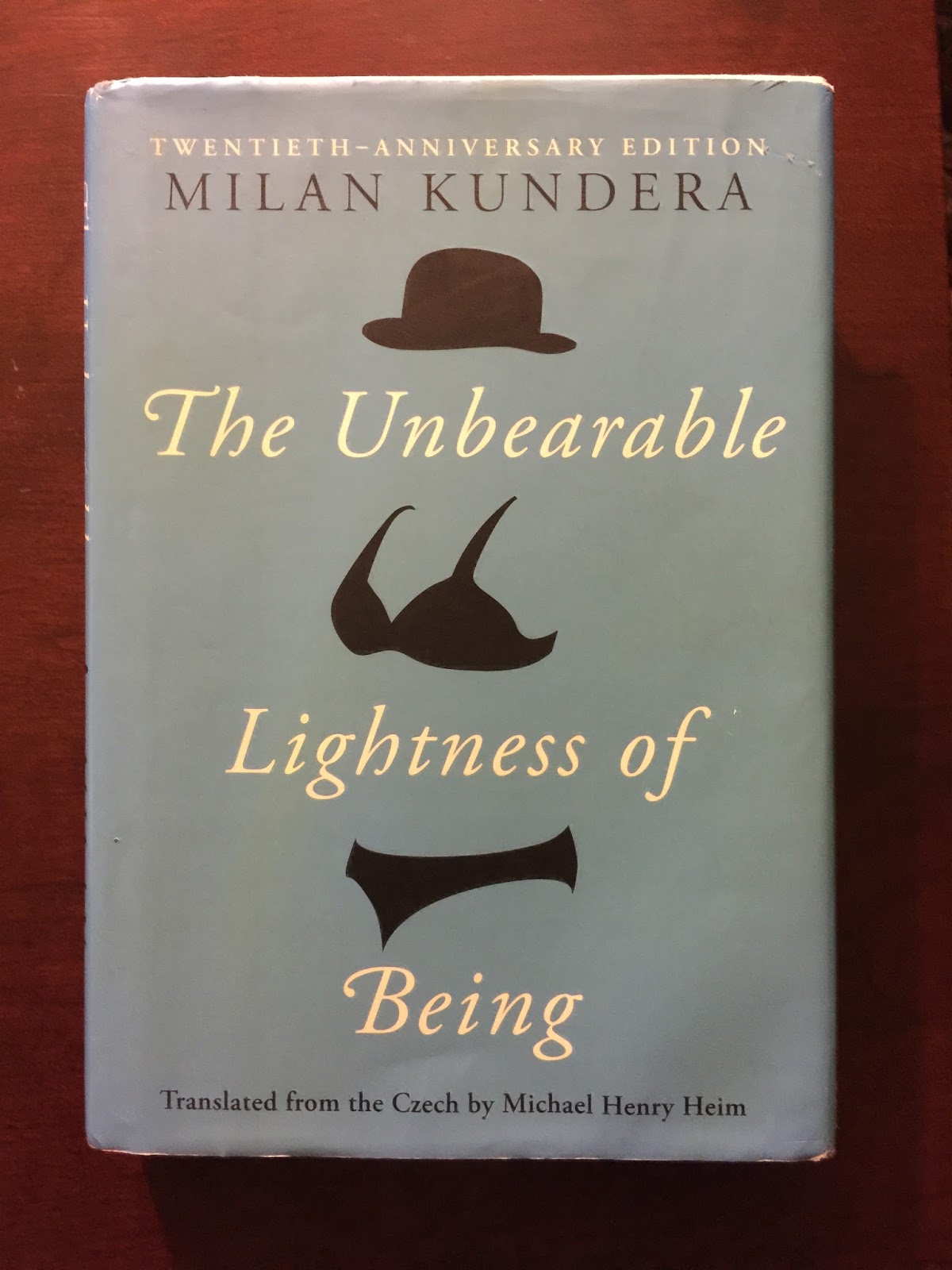
THE UNBEARABLE LIGHTNESS OF BEING: BY MILAN KUNDERA

THE UNBEARABLE LIGHTNESS OF BEING

 BY

 MILAN KUNDERA


THE UNBEARABLE LIGHTNESS OF BEING: BY MILAN KUNDERA 1984
.

It rarely happens that as soon as you finish a book, you start reading it again from the beginning, This is what happened to me with this book.

Watching me go through some  'metamorphosis' at this time of my life, my son gave this present to me.

It is a genre not known to me from before, the philosophical fiction.

Milan Kundera is a perennial Nobel candidate. He is a Czech national, lived through the vicissitudes of Russian invasion, left the country and is now a French citizen. 

There is a story but then there is the philosophical axis. It is there on every page. You can read any page out of the book. and it will stand alone like a day book. You will get something out of it, even if you have no idea of the story line running along.

It basically is a counter argument to the Nietzsche's concept of  'eternal recurrence of the same'.  
Simply put, Nietzsche put forward a possibility that there can be a limited number of occurrences and in the infinite time, they have to keep on recurring.

Milan argues against that, claiming that the burden of eternal recurrence is very heavy. It will keep the individuals down as they have to carry this burden. As we often say we have the burden (or baggage) of culture, history, religion, family values etc which keep on burdening us as time goes.
Once one is relieved of this burden, life will be very light and easy to handle.

Then he tells a story.
During the whole story, he builds the philosophical argument and the reader slowly falls into the trap of his argument. That is the beauty of the story.

Prague Spring is perhaps the first of the 'Springs'. The Arab Spring in last few years gets its name from Prague Spring. "Spring" because there was a period of political liberalization with the hope of better times to come. It did not happen then and it did not happen with the later 'Springs', including Beijing Spring a decade later and Arab Spring in early 2010's. 


Story itself is based in his home country, former Czechoslovakia, in late 60's and early 70's.  Now a former Soviet bloc country, it was the time when the communists were in charge and Soviets invaded as communists started to think of spring and openness. Result was a total crackdown and a despotic dictatorship. 

It bore a lot of similarities with the time I grew up in Pakistan. Similar kind of totalitarian government, although not communist, but still dictatorial. You see the same application of deep state tactics. We see how a successful professional, a surgeon, gradually goes down the social and economical ladder and in the process, realizes the burden being shed and feels the happiest and lightest towards the end. 

The protagonist's character reminded me of many people around me. I have seen some good friends who started with a good worldly life and then life dealt them a bad set of cards; especially a friend who has lost the privilege to work as a physician and is now a state guest. 

Czechoslovakia was a modern country, socially and economically more advanced than USSR and when the soviets moved in, they faced an advanced and liberated country, including its women. The interaction was interesting and eventually let down the cultural and social level of the nation. It was a more oppressive ideology taking over and dragging the whole culture down with it. Again something which we have seen happen in our backyard in our own lifetime.

A few deep observations I could not resist not to share.

Citing the examples of characters in the novel, he mentions four type of people who long for different set of eyes, which could be a sit in for need to be noticed. 
One, who long for unknown set of eyes. These are the fame seekers, like artists etc. They feel happy that many people know them, even if they are not close to them in real life. They bask in that limelight, even if it they are under real or imagined scrutiny by the secret service and deep state. They thrive in that.  
Second are those who long for many familiar set of eyes. These are people who want to be popular in their own circles. They are the one who throw parties and be sure they are talked about all the times. They are heavily dependent on others for their happiness and have to actively maneuver that popularity. 
Third are those who want to be in the eyes of those few whom they love. They are the lovers, who want to please only the one they love and do not care much about the rest of the world. 
Lastly the fourth type are those who look for the eyes of those who are  not present there. They are in search of ideal and look for approval of their ideal even when no one is looking. They are the dreamers and idealists. 

Another astute observation is about the two type of men who have many relationship with women.
One are those who look for one women in every women. You see that most of their women have many things in common and their friends some times call all of them by the same name. They soon get fed up by one women and move on. They earn the reputation of being unfaithful by their women. 
You can see the examples of these men in people around you.  At least one popular national leader of Pakistan has that trait. All his women look similar in some ways. 
The other type of men are who look at each women in a different way and want to explore that uniqueness about that person. They have more passionate relationship and even when they move one, there is not that sense of abandonment by their women.

Another great quote and I am paraphrasing. If the powerful are too weak to kill the weak, the weak should get strong and leave. 

How you are defined after death is largely dependent upon your heirs, form the inscription on the tomb stone to how and what you felt in the last days of your life. 

Kitsch is excessive sentimentality and thus is considered in poor taste. In its metaphysical meaning is the absolute denial of everything which is unacceptable. We do that in all belief systems. For example, man is created in the image of God but God cannot have alimentary issues ( Intake and output); every thing is best in a Communist society, ( or for that matter, in a religiously devout society) and so on and so forth. Some people dwell in it and others try to run as far away from it as possible. 

And so many more astute observations like that. 

It was pure joy to read the book and recommend to anyone who has not read it and likes the philosophical axis of everyday life experiences