Monday, January 12, 2015

Touring Multan, with Shakir Hussian Shakir

Revisiting the Past

In a City of Living Dead

گدا و گورستان


https://www.flickr.com/photos/nasirgondal/16232140776/sizes/c/in/photostream/
During the recent trip to Multan for APPNA Winter Meeting, I took a city tour arranged for APPNA members and their families. I have lived in Multan during my first years of medical school at age 18-20. It is a city with lot of influence on me. 

And for the last several years, almost for two decades, for various reasons, whenever I visit Pakistan I go to Multan. I spend a day or two visiting my class mate Shakeel Ahmed of Biochemistry in Nishtar. We remisnice on our old days, usually have a sitting with old comrade Salamatullah, now retired from Forensic Deptt.  Zafri Shah, from Khanewal is always gracious, visits Multan and then usually accompanies me to a trip further south to Bahawalpur and Yazman. 

So I go to Multan every year, but hardly visit the city. Just spend time with friends and move on. I never feel myself as Multani, but do feel a certain sense of allegiance. Taking the trip as a tourist with a guide is always interesting and now I had an opportunity to visit the streets of the past, so I jumped on the tour bus.

APPNA Winter Meeting was arranged by Haroon Durrani, whose family is a centuries old resident of Multan. His father in law, Late Umer Kamal Khan, has written a book on Multan's history and has been pivotal in restoring the Library of Multan. 

The local host committe headed by Ijaz Masood and team had arranged a great program, which was toned down due to the Peshawar massacre.

For the tour they chose well the guide. Shakir Hussain
a lifetime Multan resident, a literary person with a deep sense of Multani Pride. His guidance made it all worthwhile.


https://www.flickr.com/photos/nasirgondal/16071916029/sizes/z/in/photostream/


Almost all of what I write here is what I learnt from him. 

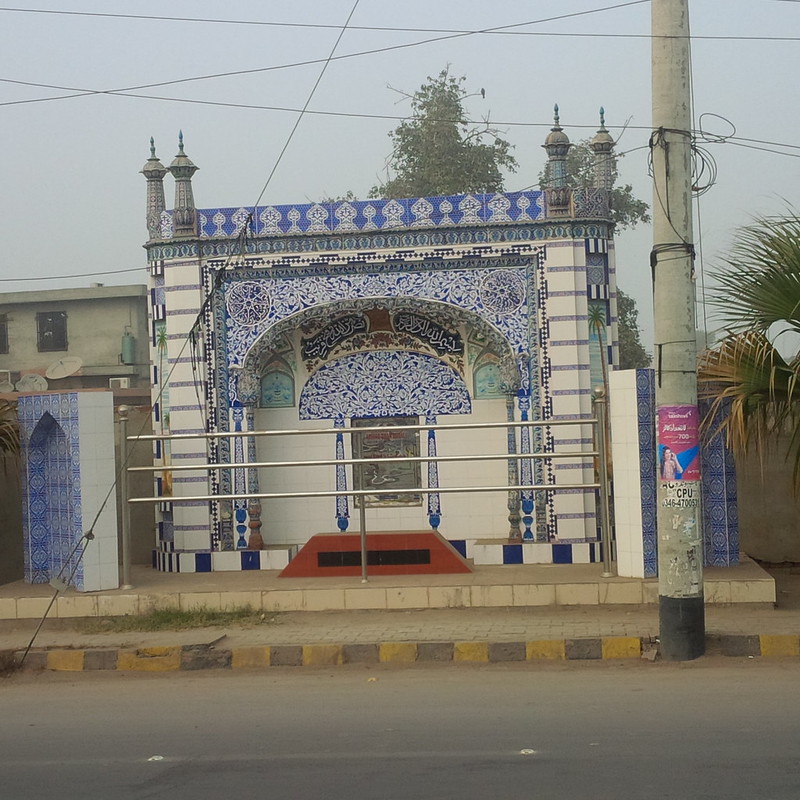
We started off from the Hotel, which is on Abdali Road. It is called Abdali Road as it is believed that Ahmad Shah Abdali was born in Multan. He was soon returned to Afghanistan and never lived here as an adult. There is a monument to commemorate that.
https://www.flickr.com/photos/nasirgondal/16070684790/sizes/c/in/photostream/


Multan, Shakir said, is continuously inhabited for 3000 years by now, making it one of the oldest cities.

The road took us straight to Bohar Gate. The old city of Multan has six gates, Bohar, Pak, Haram, Dehli, Daulat and Lahori Gates. 

I remember Bohar Gate well. During my time as a student, somehow I got fascinated by the Beeri smoking and switched from Gold Leaf to Beeri Smoking. It is tobacco wrapped in the Beeri leaf, which is dried kachnar perhaps. The place to go for beeri was Bohar Gate.

Multan is a city of saints, The oldest saint in Multan was Moj Darya. I always thought that a place called Pul Moj Darya was perhaps a bridge on a vigorous river, since dried. I did not know that it was the name of a saint.

The second saint to come to Multan was Shah Gardez, from Gerdez of Afghanistan. His tomb is inside the Bohar Gate. It is believed that in those days, the wall of the city was flanked by River (perhaps Chenab) and every year it used to cause havoc to the city during flood season. The first miracle of Shah Gardez was to put his shoes in the rive and order it should never flood again. And so did happen.

We toured the city along the wall, on the outside. Next came Pak Gate. Here is the tomb of Musa Pak, a descendant of Abdul Qadir Gilani and forefather of the ex Prime Minister Yousuf Raza Gilani.  Then came Haram Gate. We always thought it is called Haram Gate as it is the red light area and many of my college friends entered manhood through these gates. Shakir Hussain told us that it is called Haram Gate as it was the exclusive entrance for the aristocratic ladies of the times. 

Similarly Daoulat Gate is called so for the reason of having the tomb of a saint Daulat Shah. 

My first encounter with Multan was at Daulat Gate. My uncle, Taya Afzal, used to live there. He was a professor of Physics in Emerson College. As a kid I was there when another uncle of mine, Mammo Munawar, got married in Fort Colony Multan, we had gathered at Taya Afzal's house to prepare for the Baraat Procession. And when I went to Nisthar, he was still there, although retired for a long time. I spend my first few days in his house before shifting to the campus.

Back to the tour. We had the traditional breakfast of the city, Aalo Bhi Chole Pura,  a mixture of Potatoes and a vegetable called Bhi with chick peas and a hard purra. Made at night by women at homes and then brought to the streets by men and sold hot or cold. 

Part of the old wall is being rebuild from a grant by an Italian organization. It will restore the old look to the part of the walled city. Next we saw the Khooni Burj, the  Bloody Bastion between Dehli Gate and Pak Gate http://en.wikipedia.org/wiki/Bloody_Bastion#mediaviewer/File:Khooni_Burj_or_Bloody_Bastion_Multan.jpg


Thought of as the place where Alexander was defeated and the Tower was all bloodied by the defending warriors. But perhaps the name is due to the war between Sikhs and British.

Right on top of the Tower is the Students Tazia, Shagird ka Tazia. 


https://www.flickr.com/photos/nasirgondal/16258049065/sizes/z/in/photostream/

Multan, famous for its Muharram Shia processions, has two famous tazias Ustad and  Shagird, i.e. Teacher and the Student. Perhaps at some time the Student thought that he can make a better Tazia than his Teacher he made one and now this is the place from where its procession starts.  Interestingly, Shakir told us, that most of the licences to hold Tazia ( which total more than 100) are held by Sunnis and not by Shias. Shagird's Tazia is similarly owned by a Sunni. That is a unique example of Shia Sunni understanding in Multan. Skeptics say it is the way the sunnis exploit the situation financially by subletting the licenses to Shias. 

The Tazia of Shah Gardez, where I had attended some shia majalisis as a student, is not taken out and is buried at the end of the month. Perhaps there was a time of prosecution and it was observed in secret. Now the tradition continues. 

Shams Sabswari, sometimes wrongly assumed to be Shams Tabriz is another well known saint of Multan. Now there is a big park around the tomb. In our college days, there was a big mela on the urs of Shah Shams. That was the first time I had seen a live performance of dance girls. Still remember the famous song Mathe pay sonay ki bindya lagaai  https://www.youtube.com/watch?v=pHzBCqA5H8s

Then the trip to the fort. It is in the center of the walled city and hosts the two main monuments Bahudding Zakaria and Shah Rukn Alam. There was a third building, that of the Hindu Temple Prahladpur. It is here that the Hindu custom of Holi, started here http://en.wikipedia.org/wiki/Prahladpuri_Temple,_Multan

In the aftermath of the destruction of Babri Masjid in 1992, almost all of the Hindu places of worship were destroyed, including this iconic temple

Said to hear that although there is Hindu and Sikh population in Multan, they do not have a shamshan ghaat to cremate their dead. Now they bury their dead, the same way as Muslims. The intolerance has gone up with time.

Now they have built a Damdama view point at the Qila, and one can get a great view of the city. It was quite foggy on the day, we were there and could not see much, except the birds and the misty sky.


https://www.flickr.com/photos/nasirgondal/16070521818/sizes/m/in/photostream/
The old shop Nigar Khana is still there and you can get the cheapest deals of artifacts there. Sajid and Rubina bought almost all of what was left by others, for their new house in Orlando.

The Tomb of Shah Rukn e Alam, is the top most location in Multan and every visitor goes there. I had the question of the six pointed stars in the inner wooden door which I noticed the first time I visited the Mazaar after being aware of David's star, and asked the question to Shakir Hussian. He thought the resemblance is coincidental and must have been the innovation of the artisans without knowing the Jewish connection.


In this city of saints, the more recent entry is of Molana Hamid Ali Khan, the religious leaders of Rohtak Hasar migrants to Multan.  

In the end, on the way to the renovated Library, which Umer Kamal Khan help renovate, but did not live to see it inaugurated, we did go past the Graveyard where Attaullah Shah Bukhari, the famous orator and Deobandi leader is buried, perhaps in an unmarked grave.


Tuesday, November 11, 2014

ARE YOU AN ETHICAL PERSON?

A Lecture by Tom Cooper

@

Emerson College, Boston

This October, I attended my first lecture on Ethics. It was Haleema's Family Weekend (Parents Day) and there were mock lectures for parents to attend. I wanted to attend lectures in her course but she encouraged me to attend those I find interesting. This was an interesting topic so I decided to attend.

We, growing up in Pakistan, were never exposed to the subject of ethics in our schooling. Religion was and is considered the ultimate source of ethics and morality. As long as we have learnt the Book and the Tradition, we perhaps do not need anything else. We were encouraged to think that the sole path to ethics and morality is routed though religion. A person without Divine connection is devoid of any morality or ethical element. With time some of us learn that mindset is condescending. Ethics predate organized religion.

 Here in the West, the study of ethics and the development of ethics in the human history is an integral part of learning.


The lecturer, it turned out, is a renowned professor in his field. Tom Cooper. His books include FAST MEDIA / MEDIA FAST, and available at Amazon. It in on my list of next book to read.


The topic was '"Are you an Ethical Person"


He started by giving a few definitions of ethics and how one type of ethics, may conflict with another. for example the ethics learnt from the home or religion/faith system may have a conflict with the ethics of the profession or the workplace; and the art is how to reconcile the conflict.


He showed a clip from the movie MASTER AND COMMANDER based on two Napoleonic War-era adventure novels in author Patrick O'Brian's Aubrey/Maturin series. In the movie the ship’s captain was played by Russell Crowe. It is rated as one of the best Naval movies.

He takes the ship on a rough and dangerous course. This is in search of prize. In this risky adventure, some of the sailors have to be on the rudder and try to steer it in a certain direction in a turbulent and stormy sea. As a result of the rough sea, one of the sailors, who is quite liked by everyone, falls off with a large piece of rudder along with him. The rope attached to the ship is now pulling the whole ship in one direction. There is a real danger that the whole ship may sink if that continues to happen. As all the hopes of rescuing the man are lost, the captain makes a decision to have the rope cut off, thus drowning the sailor in the turbulent sea. The ship is saved and all the worried crew and the slaves on the ship are happy and relieved.


After showing this clip, the professor posed the questions. 

Was it an ethical decision? Saving one man vs the possibility of drowning the whole ship.
What if the life at risk was not one vs 100 but 10 vs 100 or 50 /50?
Where would one draw the line?
Was the Captain right in the first place to take the whole ship in risky waters? etc


Then he enumerated 12 characteristics of ethics and posed which one we identify as the top three important aspects of an ethical question. This he juxtaposed to four persons he has studied as a part of his next book, "Profiles in Moral Courage".  He started by writing about the moral courage and the difficult ethical decisions by Abraham Lincoln. He ended up by comparing him with four persons in the recent history. Nelson Mandela, Gandhi, Mother Teresa and Rachel Carson.


All had to make some tough ethical decisions in their lives. We all face that. The question to ask is:
How you know whether your decision will be an ethical one?
 The history of Ethics development is long. Earliest sources would include Aristotle, who favored a medium path; something between deficiency vs excess. 
Immanuel Kant, simply put, would look at it with a question."What if every one do that, would it be good?" He emphasized to treat everyone as an end and not as a means.

John Stewart can be included in this list. Greater good; utilitarian approach is the way to reach an ethical conclusion in every case. 

And then we have our religious sources, Biblical Golden Rule, Buddhist, Tao etc
 So, in his own words, how you decided if one is making an ethical decision or not.

When you are about to make a decision, what impact it would have in the following areas. Some are overlapping, but still separate ends.

  1. Peacefulness. Will the outcome bring peace vs otherwise
  2. Equality: Will the outcome promote equality
  3. Justice: Will justice be served by the decision
  4. Compassion: Is the decision compassionate to people affected by it
  5. Forgiveness: Does it promote forgiveness
  6. Unconditional Love: self explanatory
  7. Non Discrimination:
  8. Unity: Will the outcome bring people together in a quest of unification
  9. Fairness: Is the decision fair to parties involved
  10. Inclusiveness
  11. Survival for All: Does the decision assure survival of all including non humans
  12. Humanitarianism
In his analysis the four personalities he studied had different priorities.

Gandhi:
  1. Perfect Outcome: The Brits were leaving and although Partition was not what he wished, he had to agree to something which has the least risk of worst outcome
  2. Equality
  3. Justice
Mandela:
  1. Non Discrimination: was the top most priority for him
  2. Unity: of the country was the second most
  3. Fairness: would come next
(Mandela in a dialogue with Gandhi's grandson Arun, was not as much committed to non violence as Gandhi would have been)

Mother Teresa:
  1. Compassion: consistent with the religious tradition
  2. Forgiveness
  3. Unconditional Love
Rachel Carson: The pioneer environmentalist
  1. Inclusiveness: environment issues
  2. Survival of all: including non humans, and the future generations
  3. Humanitarianism 
Chose your one top three and see where you stand.


At the end of the lecture I walked to him and had a little chat. I asked who is an example of ethical standard in today's time one should look up to. 

He responded: Malala

Thursday, August 28, 2014

Ah! Cader Cheique

Abdul Qadir Sheikh As I Knew Him

https://www.facebook.com/cadercheique?fref=ts


Abdul Qadir Sheikh is a big name. The saint of Baghdad. Invoking the Divine power of qadr and fortitude, it is not easy to fill the shoes of someone with that name. The Abdul Qadir I knew, was no less than the name his parents chose for him.

I cannot say surely how long ago, but it was around 15 years back when I must have first met him. This was the time most of physicians of my age were settling in. We had a relative level of comfort in our jobs. We all felt the need and had the time to reach out and explore the wider community around us. The NY Chapter of APPNA was already established and had undergone a kind of 'awami' turnover. Skeptics have started to join and eager to explore what was in it for them, socially and politically. A regular process of annually elected slate of officers was in place. Many of us who had done our residencies in NY area knew each other through friends and collegues from different geographic backgrounds and alumni associations. 


It must have been in one of the NY APPNA meetings that I first met him. He was the most shy, humble and private person, until you knew him a bit; and he started to talk. He was one of those where the first impression is the farthest from the final impression. And strangely, you would hardly find anybody who would think of him differently. Everybody liked him, enjoyed his company and nobody harbored any ill will towards him.


Those who stay behind in NY are either tied to a rope of family and personal interest, (with a short leash), or are able to appreciate the richness of life over the life of riches. He perhaps had both the reasons. He had a large family in the NY area and wanted to bring up his family in that network. He also had less than average interest in the worldly markers of success. He was most content with what he had and you could not find a person more satisfied than him.


He had a job in Elmhurst, a city hospital with all the benefits and limitations of a city job, including a predictable time table, fringe benefits and the luxury to do what ever you wanted to do after 5 pm; an option not available to most of us.


I say that because it helped him experience the life, as he had a shorter life sentence than most of us, to the fullest. Perhaps a lot fuller and richer than most of us would wish in a short period of time. At the same time, he was able to help many in the community who could not afford health care. He was right there, a stone throw away from Jackson Heights, and in the middle of a major city hospital. I have asked him innumerable times to help someone get medical care. He was always gracious to take care of that.


NY Chapter of APPNA used to have four or five councilors. Usually the senior most would later graduate to become an officer, a treasurer, and later move up every year, eventually to the top. He and I perhaps served the longest  tenure as a councilor. He was one year ahead of me, and each year we both passed on the offer to move on. Eventually everybody got tired of us and accepted our request to leave us alone. We shared this unusual problem of not willing to take more responsibility while offering abundant supply of free advice.


It was around six years back when he found out what eventually took his life. He came to know the diagnosis just before a major event he had to arrange, and he kept it to himself. He was the chair of the local host committee for the Annual Retreat of DOGANA, the Dow Medical College Alumni Association. He had colonoscopy before and got the results a day before that. He did not let anybody know about it, or anybody guess about anything wrong, and had the show go on.


In fact this was most typical of him, and one would see time after time. As his disease progressed through each subsequent intervention, he was able to have the show of life go on. He did not let the people around him realize the depth of anguish and pain he was going through. I deal with cancer patients everyday as a part of my livelihood. I have not seen someone like him who kept his dignity to the last, and had been most sensitive to the feelings of others around him even in the twilight hours of his life.


He had kept his head high and lived with grace. The prolonged duration of his illness, gave enough time for his kids to grow up much earlier than their age and deal with the final eventuality. It seems to me that some how Qadir kept the fate at bay. He has proven to be a real Abdul Qadir, invoking the divine power of fortitude over adversity. He stuck around long enough to see his family safely take off without him.

In these days of qehtur rejaal, he was one of a few with whom I could have a deep conversation on any aspect of philosophy, social issues, meaning of life, afterlife and beyond. He was truly enlightened who could understand the depth of the issues and communicate at your level, what ever it is. 

On top of that, he had a unique sense of humor. He could make jokes with a straight face. I do not know of anyone hurt by his words or actions. He tried to bring people closer. Even in the last stages of his life, he had tried relentlessly to bring old friends together who had drifted apart. I hope people remember him for that.

(His last Facebook picture)


I was not one of those close to him. Later in his last few years of disease, he got more private regarding his illness, and I was unaware of many of his hospitalizations and details of his course. 

He became a more private person as he did not want people to offer empty empathy. I respected that and moved back two steps. 

In spite of all that, or perhaps because of it, I feel the loss of a dear friend and I really miss him.

Alwida, my friend Abdul Qadir Sheikh

 
 https://www.facebook.com/photo.php?fbid=10203543643404513&set=a.10202073181123875.1073741828.1017490571&type=1&theater

Courtesy Iqbal Jandga


 https://www.flickr.com/photos/nasirgondal/1213165101
With Pervez Qureshi at NY APPNA Picnic 2006, Sept 10th.


Friday, August 22, 2014

APPNA Gives Back

This is one of the videos shown during the APPNA Banquet on August 16th, 2014 at Gaylord National Harbor

The chair of the Local Host Committee had asked me to come up with a slide show of APPNA's work. He thought that many of the banquet attendees may not be aware of the social and charity work of APPNA. It may help people be aware of the projects of APPNA.

When I started to collect pictures, I realized how spread out the pictorial history of APPNA is. There is really no good archival collection in the office. Each year APPNA publishes three to four newsletters/journals with many pictures in them. The record of the pictures are not available in the office. I tried many directly and others through the APPNA blast mail. Many complied and their names are acknowledged at the end of the video. Much more could have been shown, but I did not have the pictures to show that

The basic emphasis is on the giving back by APPNA and its members to Pakistan and the adopted country in the last ten years or so. It starts with some of the cover shots of APPNA journals. That gives the artistic side of APPNA publications and its editorial team. It is followed by the advocacy work, educational projects, services to the young physicians and the disaster relief, both here in the USA and back home. Eye camps, Bone Marrow Registration Drive, Hepatitis Initiative, Cytogenetics lab, Public Health Institute and APPNA Foundation are included.

Much more could have been included but I did not have the pictures. I regret that.
I thank the local host committee to provide me with this opportunity to compile this. I commend Asif Rehman for allowing complete editorial discretion.

The video was compiled and edited on Final Cut Pro. I had no idea that a 'just a simple slide show' could be so complicated. All the technical and editing was done by my daughter Haleema. It could not have been done by me without her participation. I am indebted to her.

https://www.youtube.com/watch?v=nO-pSiJMWfA

Nasir Gondal

Sunday, June 15, 2014

Hard Choices by Hillary Clinton


Hard Choices by Hillary Clinton


Displaying IMG_00000445.jpg


A week back I got a text message from Karachi. My father-in-law wanted to be sure that we secure a copy of Hillary Clinton's Hard Choices for him to read on his next trip to NY.
Now that I have a copy, I thought to glance through it. 

I have never read her books before. In fact I have not read Obama's books either, bought by my wife when he was running for President for the first time. I promised to myself to read, if he ever got elected. It is still sitting there and Obama is almost on his way out.

So, Hard Choices covers her time as the Secretary of State. It is a big book. Has more than 600 pages and is divided into six parts. I read Part Three, which deals with Pakistan and Afghanistan. It is aptly called War and Peace, has three chapters, Afpac:Surge, Afghanistan: To End a War and Pakistan: National Honor.

In Afpac, she tells the Afghanistan story more as an observer and a reporter instead of that of an active participant. She tells the team was divided on the surge issue. Gates was in favor, Biden was against. She does not tell us her position. 

She speaks highly of Holbrooke and the AfPac initiative. Holbrooke was not liked by White House staff and many really wanted him out.

Holbrooke was with her in her office when he said, 'something is nor right', He was rushed to the hospital. The surgeon who operated and tried to save Holbrooke's aortic tear was from Lahore. She does not mention his name.

She expressed astonishment that Obama mentioned the eighteen month deadline to leave Afghanistan when he announced the surge. 

Half of chapter on Pakistan is filled with the details of Operation Neptune Spear. After it was over, President called all four living former presidents to personally inform them. When he called Bill Clinton, he assumed that she must have told him. She had not.

She mentions Zardari positively. It was her who had spoken to him after the Abbottabad incident. He took it well.

She again agreed to be the person to offer condolences to Pakistan on the 24-soldiers killings,

Benazir is the only celebrity she has waited on a rope line to see, when she was visiting London in 1987 and saw people lining up to see Benazir arrive at Ritz Hotel.

At least in these three chapters, she does not give much of space to Pakistan's issues with India and her analysis of that. She does mention in detail her trip to Pakistan where she ventured into many talk shows and media events as a punching bag. 

There is no mention of any Pakistani Army General at all. Pervez Mushharaf is briefly mentioned. There is no mention of Pakistan being a nuclear armed state.

So overall, in my review of these three chapters the views of the former Secretary of State, a former First Lady, NY Senator and a potential future US President about Pakistan are expressed through the concerns of security, Pakistan's nuisance value and the War on Terror. If any thing else is mentioned, it is her interest in the women's issues. Strategic partnership and the so called old friends during Cold War is not a drum beaten in this book. 

Thursday, April 24, 2014

Left Politics in Pakistan

A Meeting With Farooq Tariq


I got a facebook message from Dr Buttar, of a lecture by Farooq Tariq on the topic of "Left Politics in Pakistan and the building of Awami Workers Party" at NYU Sociology Dept. The topic sounded interesting and I decided to go there. If nothing else, I would meet up with some old faces. Called Bobby Khan and we decided to be there.

It was a decent size gathering round a table. Hashim Bin Rashid, the AWP Lahore GS introduced Farooq Tahir. Farooq Tahir is the General Secretary of the party.

He gave a detailed historical background of the movement for the last decade or so. The following is what I gathered. Words are mine but the thoughts and comments are his.

Society in Pakistan has moved way to the right in the last two decades or so. It is more of a theocratic state than before. In this atmosphere it is increasingly difficult to keep the message going for the progressive ideas and move ahead.

Until recently, Left in Pakistan was as fractured as before. A few years back three parties agreed, after much deliberation, to get together under one roof. His party, Labour Party Pakistan merged with Awami Party and Workers' Party in 2012 to form the Awami Workers Party. Since then it is still going through the pains of an 'arranged marriage' but still pulling through. There are still other parties of the Left, but AWP is the largest of them.

There are a few success stories, he mentioned. The party was the force behind the tenants dispute with the Okara farms, where the tenants refused to be tricked into changing their status into a Leese ( and be easily kicked out). Eventually they prevailed.  Left also claims to be the driving force behind the movement for the restoration of Justice.

Still there are many uphill tasks. When the President of AWP Abid Minto filed a petition against the repeal of Land Reforms (Shairat Court repealed the reforms done under ZA Bhutto in 72 and 77), it was a big question whether an appeal can even be filed against the ruling of Shariat courts. Ultimately the CJ Ifkikhar Chaudhry at least, allowed the petition to be filed. The case is ongoing.

The party has made some inroads in the KPK, the Frontier Province and has contested elections in Swat. It has made alliance with Baluch Nationalists and participated in their long march from Quetta to Sind and to Lahore. The Party supports the right of provinces or self determination and secession. It took its stand against the Kalabagh Dam as the smaller provinces were against it.

The Party has decided not to partner with Right conservatives on any issues as they tend to steal the show and take all the credit. It supports the nationalization of all the religious madrassas and women rights including the right of abortion.

The Right has taken many of the issues which were the broiler plate Left causes ie universal education and anti privatization. Right conservatives quote Faiz and Jalib all the times. They speak in the vocabulary of the Left.

On a personal note, Farooq Tariq was a budding journalist when he had to move into self exile in 1978 during the military dictatorship. He moved to the Netherlands and with fellow expats joined the Trotskyist movement and became a part of the Committee of a Workers' International. It was there that he has worked with Lal Khan. International Marxist Tendency, IMT, an offshoot of CWI, had  Pakistani expats in the leading role.

Later when the situation in Pakistan changed he moved back. At that time there was a split amongst many returning activists. Some decided to make inroads into the mainstream liberal parties while others including him decided to stay the course in a pure left organization.

It was an evening worth the trip into Manhattan during the rush hours. It was a time to reminisce into the past and see what is left of the Left in Pakistan and wonder that the days of our youth, which we used to think were horrible social conditions now seem much better than the days facing the youth of Pakistan these days. It also gave an opportunity to meet old lefties Ahsanullah Khan Bobby, Masood Haider and Shahid Comrade

In such a conservative leaning society, it is a success in itself to keep the light on. Quite appropriately the election symbol of the party is the light bulb. It will be a big contribution if they can keep the light on in this long dark night which has set on Pakistan.

Monday, April 14, 2014

The Concept of Umma(t)h As explained by Tamim Al-Barghouti

For many of us, the word ummah has somewhat negative connotations. It is ofter quoted as the dreamy flight of ideas of a concept which either never existed or is too fantastic.

But tonight, I came across a new understanding/interpretation of the word.

This is the best definition of Ummah I heard and want to commit to writing before I forget it.

The words are mine but the concept is of Tamim Al-Barghouti. This was after a long time that I heard a thought provoking speech at a fundraising banquet.

He is a young poet and political scientist of Palestinian father, a poet and Egyptian mother, an author. His poems had become popular and resonated in the squares, processions and streets and alleys during the Arabian Spring.

He spoke at CAIR NY annual banquet at the picturesque Grand Prospect Hall in Brooklyn.

The theme was Faith in Freedom. CAIR-NY team put up an elegant show. Ryan Mahoney has taken the organization to another level. The board is larger and very representative of the younger urban community.

Haroon Mughal was at his best. Do listen to him of you have a chance. Imam Sirah Wahhaj never disappoints. Tamim was the keynote speaker and I heard him for the first time.

People are divided into two types. One who get together on the basis of an idea, of equality, egalitarianism essentially faith. They may work together and even exist without a figure of authority. 


The other group is what is based on authority and order. It is a disciplined colonial authoritarian system, where the boundaries are fixed, rules are set, and are to be obeyed and followed. Here is only one version of truth and that has to be followed.


What happened in Tahrir Square from Jan to May 2011 is an example of the clash of the two groups. The first one, 20 million strong, stayed in the Square without a central figure but based on a concept, idea, of equality and justice.  They were able to operate a system based on common beliefs. No central authority and were still able to have an understanding of how the system has to run. The decision of not using violence against the government troops and tanks was not made by a select few and passed on to the others, the collective thinking of the whole group was a rational one and based on common sense that violence will only beget violence. The other group, ie the establishment failed despite their authority, order and organization.

This in one of the many examples he quoted in explaining the power of the people brought together based on a concept, ie as an ummat vs the organized hierarchy of Establishment, which is always either colonial or with colonial ethos. 


Colonialism is a form of oppression and its ultimate goal is to eventually transform the ruled into someone like the ruler so that they can be eventually ‘freed’. So, in Cromwell’s words, the ‘liberation’  of the Egyptians was the ultimate goal of the colonization.  So that the Egyptians can be liberated, not in the Mohammedan sense, but in a European sense.  That will ensure that the ‘independent’ states will remain somewhat dependent on the powers who allowed them to be liberated.


Same is true in the Palestinian-Israeli conflict.


In the concept of the Ummah (ummat) the base can be broadened, outside the folds of Islam, or whatever is the religion one practices. If someone believes in the universal value of justice, mercy or righteousness, that person is a part of the greater ummah as your God is Just, Merciful and Righteous. 

Contrary to what the general concept of one ummah as one nation under one rule of Khilafat, his concept of ummah is more of a shared common theme with several political interpretations and entities. He quotes that except for a short period of initial Muslim history, the Muslims have lived under more than one political establishment. But as the general concept of religion was same, the concept of ummah remained and flourished, as the community at large, was follower of a shared theme of equality, justice and fairness.

That means that the common denominator of ethical humanitarian values will make people 'one' despite different political and religious divisions, even to the extent of including non-Muslims into the folds.  In that sense the concept of Ummah is basically of the Human race at large coming together on universal themes of equality and justice.

To further his point, he gives the example of Quran itself.

Quran claims its evidence of being divine is its beauty of speech ie eloquence.  So if something is beautiful, it has to be good. Quran uses a lot of poetry, and like poetry it relies a lot on metaphor and ‘majaaz’.  In that it allows a lot of room of interpretation and exegesis and that is a quality of eloquence and beauty.

The word Ummah and Imam have the same root and it means basically a guide. It can be a person and it can be a book.  Prophet was an Imam and so is the book and later it was his life in the form of quotations and traditions.  Later it was the life of either his companions (for the Sunnis)  or the descendants ( for the Shias) which became a source or guide. So with time the base keeps on broadening and adjusts with the ethics of time.

So whatever is good, beautiful and has the values of justice and equality, has to be right and in essence within the folds of ummah.


Tamim has written five books but only one of them is in English.
The Umma and The Dawla: The Nation State and the Arab Middle East.